


%20(62).png)


.svg)



Your company runs Workday. So when compensation planning comes up, the answer seems obvious: just use the comp module. One vendor, one data source, fewer integrations to manage.
On the surface, this makes sense. Until you're deep into your first merit cycle.
A mid-cycle promotion wipes out a planned increase. Your consultant bills another 3 hours to fix a bonus rule. Hiring freezes because the cycle is live. And somehow, your team is still finishing the cycle in spreadsheets.
It's not a configuration problem. It's an architecture problem.
As one reviewer put it: “The system is not able to accommodate some common business scenarios in compensation administration. It is very difficult to change the supervisory org set up once implemented."
Workday is a powerful HCM platform. Its compensation module, however, was never purpose-built for the high-stakes, constantly shifting demands of comp planning. And in 2026, that gap is getting harder to work around.
The fix isn't replacing Workday. It's replacing the part that's slowing your team down and syncing everything back seamlessly.
Here are five platforms built to do exactly that.
Why do Workday users look for compensation alternatives?
Here's what comp teams actually run into:
Your comp process has to fit Workday, not the other way around
Running compensation on Workday's module means working within what Workday can handle. Custom proration logic, non-standard eligibility rules, multi-tier approval workflows, region-specific guidelines, if your process doesn't map cleanly to Workday's architecture, you either simplify your comp philosophy to fit the tool or build the real process outside it in spreadsheets and macros.
In most cases, it ends up being both.
Promotions mid-cycle can erase planned merit increases
Pay events in Workday sequence chronologically. The last event wins. So when a promotion processes while the global merit cycle is live, it overwrites the planned increase. HR finds out when the numbers don't add up and spends the next few days reconstructing corrections in spreadsheets, close to payroll cutoff.
Planning cycles freeze your HR operation
Many organizations freeze their production environment during merit and bonus cycles, no new hires, no promotions, no transfers, to avoid event-sequencing conflicts. For weeks, sometimes longer. Business doesn't pause. But HR ops effectively does.
Every change needs a specialist
"Configuration changes require a long lead time. External consultants are a necessity for successful initial implementation." — Jacob P., Capterra
That dependency doesn't end at go-live. Changing a bonus rule or adjusting eligibility logic requires relaunching the entire process, and for most teams, that means a call with a consultant.
The planner experience is an afterthought, and it shows
“It looks exactly the same as all the other pages. seems like workday just tries to use a certain template and bends its capability to not have to build featured products. For something like compensation, they should rethink this strategy.” - Daniela S.
Workday uses a standard template across modules, so compensation doesn't get a purpose-built experience. It gets the same interface as everything else.
When the tool feels like a system to get through rather than one that helps, managers disengage or fall back on spreadsheets. Routine mid-cycle adjustments become escalations. Planning accuracy drops, not because people aren't trying, but because the system makes it harder than it needs to be.
None of this means abandoning Workday. The pattern emerging in 2026 is clear: enterprises keep Workday as their system of record and run compensation in a purpose-built layer that syncs approved decisions back.
Here's how we evaluated the five most viable options for doing exactly that.
Letter generation becomes a bottleneck at the finish line
The final step of any comp cycle: generating and distributing salary increment or bonus letters, is where Workday users consistently hit a wall.
At high headcount, letter formulation requires manual configuration, custom templates, and often vendor involvement just to get formatting right. What should be the moment employees experience the outcome of the cycle becomes a weeks-long admin exercise for HR.
It's the last mile of compensation, and for most Workday teams, it's the hardest one.
5 Best Workday Alternatives for Compensation Management
Here are five platforms built to replace the comp module, not Workday itself.
1. Compport
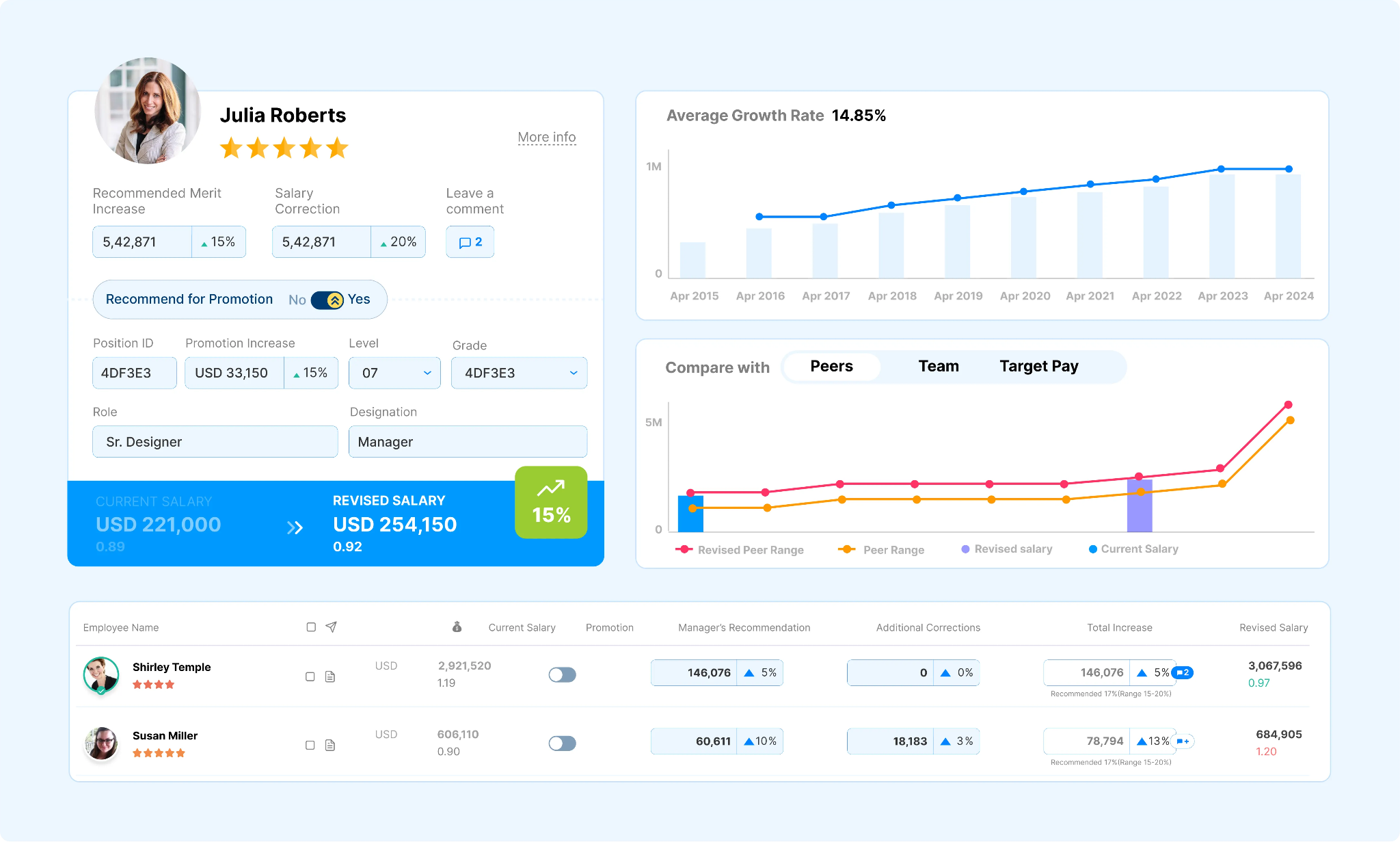
%20(95).png)
%20(94).png)
%20(93).png)