




%20(69).png)


.svg)



In 2019, Citigroup did something no major US bank had done before. They published their gender pay gap. Not the adjusted figure companies usually lead with, but the raw, unadjusted median: 29% lower pay for women than men across the organization.
The reaction from markets was largely neutral. Which, if you think about it, tells you everything. Investors had already priced in the assumption that a gap existed. What surprised them was that Citigroup chose to say it out loud.
That decision didn't cost Citigroup. What costs companies is the alternative.
Goldman Sachs settled a gender discrimination lawsuit for $215 million (Reuters, 2023). Google settled a similar case for $118 million (U.S. Department of Justice, 2022). Oracle for $25 million (EEOC). These weren't companies that set out to discriminate. They were companies that didn't look closely enough, didn't correct what they found, or didn't communicate what they knew.
Pay transparency, done well, is what closes that gap between what you don't know and what a court eventually finds out.
This article looks at the organizations that have done it well, the ones that haven't, and what the data shows about the difference in outcomes.
Pay transparency isn't one thing
Ask five compensation leaders what "pay transparency" means and you'll likely get five different answers. That's part of the problem.
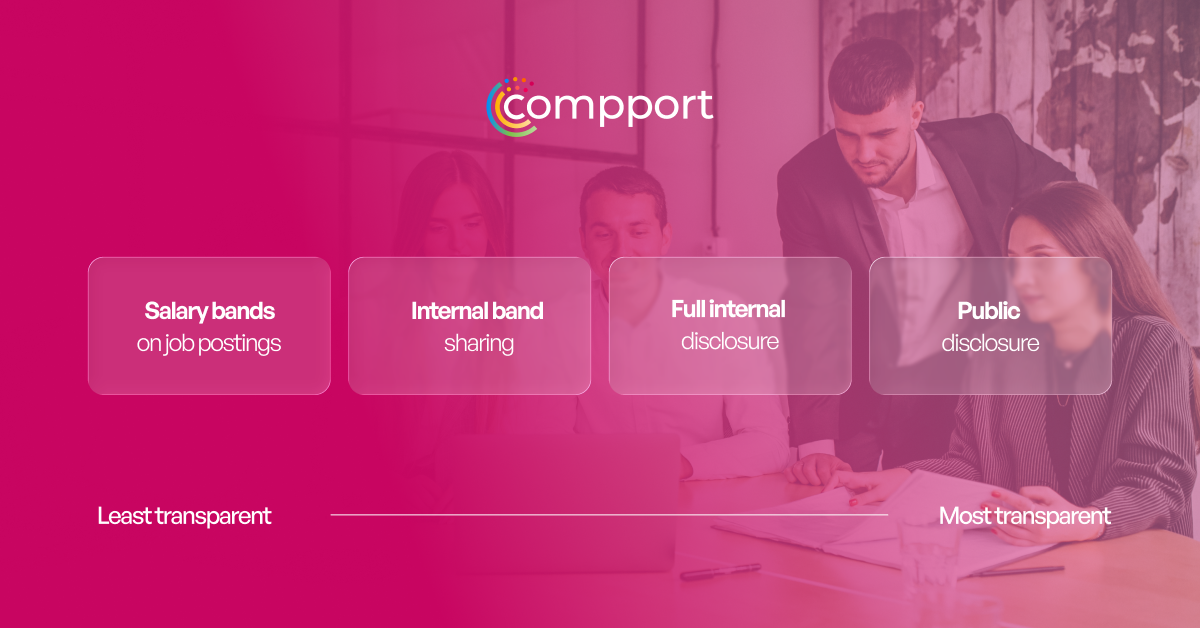
For some, it means posting a salary range on a job listing, sometimes so wide it tells candidates nothing (SHRM found that before state laws forced the issue, only 45% of US companies were sharing salary ranges in postings at all). For others, it means employees can see the band they sit in, but not what their colleagues earn. A smaller group has gone further: full internal disclosure, where anyone can look up anyone's pay. And a handful, like Citigroup with its gap disclosure, have taken it public.
These aren't four versions of the same thing. They're four different business decisions, each with its own risk profile and its own payoff.
Most Fortune 500s sit somewhere in the first two categories right now, largely because regulation forced their hand. Colorado, New York, and California didn't ask companies to disclose everything. They asked for ranges on job postings. The EU Pay Transparency Directive goes further, requiring it at the application stage across member states by 2026.
But the companies seeing measurable ROI are the ones who picked a level of transparency deliberately, then built the infrastructure to support it.
What happens to your talent pipeline when you post salary ranges
Microsoft didn't wait for a law to tell them to add salary ranges to job postings. They started doing it across most US states before it was required, and the reasoning was simple. Candidates were already asking. Recruiters were already fielding the question in the first call. Might as well answer it upfront.
That instinct lines up with LinkedIn's own research. In a survey of over 1,000 US-based members, 91% said a posted salary range affects their decision to apply, and 82% said it leaves a more positive impression of the company.
LinkedIn's Workforce Insights found 85% of Gen Z candidates say pay transparency affects where they choose to apply. For a generation that's about to make up a third of the workforce, that's not a preference. It's a filter.
Salesforce saw something similar from the inside. After they began publishing internal pay bands, offer acceptance rates improved, and so did the trust scores candidates reported during the hiring process.
%20(94).png)
%20(93).png)
%20(92).png)