




%20(91).png)


.svg)



"AI" in comp software now covers everything from assistive features in market pricing to agentic systems that work inside the live cycle.
The five platforms compared here: CompportIQ, beqom AI, Payscale, Compose AI by Decusoft, and HRSoft Intelligence.
CompportIQ runs purpose-built agents on live cycle data, with every number computed by tested engines and every recommendation approved by a person.
Payscale's AI is strongest in market pricing and job matching. Decusoft and HRSoft suit heavy variable pay, LTI and carried interest.
Judge the AI by where its numbers come from and who approves the output, not by how many agents are on the product page.
Every compensation vendor has an AI story now. Open any product page, and you'll find agents, copilots, assistants or "intelligence" somewhere above the fold.
The problem is that the word covers very different things. Some platforms use AI to match jobs to survey data. Some put a chat window on top of reports. A few run agents that work inside the salary review itself, on live data, under the same rules and approvals as the rest of the cycle. Those differences decide whether AI saves your team weeks or adds one more output someone has to double-check.
This comparison looks at five platforms and what their AI actually does, so you know what to ask for in the demo.
You're reading this if
- Your comp team spends more time answering analysis requests than making decisions
- You're weighing merit budget models before the next salary review
- You're bringing two job structures together after a merger or reorg
- EU Pay Transparency Directive reporting is on your roadmap
- Leadership wants AI in comp, and IT and Legal want to know how it's governed
What is AI compensation management software, and do you actually need it?
You probably need it if a few of these sound familiar:
- Analytics requests queue behind one or two analysts
- Pay equity analysis happens once a year, or goes out to a consultant
- Merit budget scenarios get rebuilt in spreadsheets every cycle
- Pay transparency reporting deadlines are getting closer
Agentic AI vs AI agents: which one does comp actually need?
An AI agent does one job when you ask it to. It writes a formula, answers a question or drafts a report. It's useful, but you still decide what to ask, in what order, and you stitch the answers together yourself.
Agentic AI is a system that takes a whole request, works out the steps, and routes each one to the right specialized agent. Ask "what would it cost to close the pay gaps in engineering without breaking budget?" and it pulls the data, runs the equity analysis, models the options and explains the result.
For comp, agentic is the more useful model, with one condition. The numbers have to come from tested calculation engines, not from the language model, and a person has to approve anything that touches pay. Autonomy on its own isn't the goal. Getting to a defensible answer faster is.
How we evaluated the top AI compensation management platforms
Every platform here was assessed against the same six criteria:
- Where the numbers come from: Are figures computed by tested calculation engines on your data, or generated by the language model?
- Human approval: Does a named person approve before any output changes a pay record?
- Role-aware access and data privacy: Does the AI only see what the person asking can see, and is your data kept out of model training?
- Lifecycle coverage: Does the AI reach planning, pay equity, benchmarking, budgets and analytics, or just one of them?
- Explainability and audit trail: Can a manager see why a recommendation was made, and is every action logged?
- Fit with your existing HRIS and comp setup: Does it work with the systems and rules you already run?
Sources: vendor product pages and announcements, as of September 2026.
The 5 best AI compensation management platforms compared
1. CompportIQ
CompportIQ is the AI layer inside Compport. It's built on a platform that supports 1.5M+ users across 300+ customers in 37+ countries, and it works like a veteran comp analyst at your side.
Six purpose-built agents are live today: Pay Equity, Benchmarking, Comp Planner, Budget Management, Calibration, and Analytics. Each one works on your live data, inside the same rules, bands, and approval chains your cycle already runs on.
Use cases
- Harmonizing job architecture after a merger. Load both job architectures and CompportIQ proposes a single harmonized framework, matching roles by work, scope and level rather than title, with a confidence score on each mapping. Exceptions are flagged for your review. The equity and cost-to-remediate analysis runs in the same pass, so you can tell the CEO what Day 1 actually costs, not just what it might cost.
- Planning pay remediation. CompportIQ shows where internal parity breaks, where pay is out of line with the market, and who sits more than 10% outside their agreed position. It then models the options: fix the biggest gaps first, prioritize critical talent, or phase corrections over time, with a budget for each.
- Building the salary review model before the cycle opens. Put more weight on performance, move people below market faster, change the increase matrix or adjust the budget. Each scenario takes minutes, and each shows its cost and whether it strengthens pay for performance, improves market competitiveness or creates a pay equity concern.
- Catching pay equity risk mid-cycle. Check whether proposed increases would create or widen a gap, and which decisions to revisit before approvals close.
- Benchmarking on demand. Compare a team against your licensed market data on the spot, across functions and geographies, instead of commissioning a review that arrives after the decision.
- Answering analytics questions in plain English. Pay positioning, compa-ratio spreads and budget consumption come straight from live, role-scoped data, with no export and pivot required.
Key features
- Deterministic engine: Every number is computed by tested engines on your data, so the same inputs always produce the same auditable result. The language model explains results; it never generates figures.
- Explainable recommendations: Every recommendation shows its reasoning, and every assumption can be challenged and changed.
- Role-aware access: Agents run with the permissions of the person asking, enforced at the data layer. An HRBP sees their client group, a manager sees their team, and AI never widens access.
- Human approval: No output changes a record without a named person approving it.
- Full audit trail: Every action is logged with the user, timestamp and the basis behind the recommendation.
- Data privacy: Your data never trains any model and stays tenant-isolated.
- Certified security: ISO 27001 and SOC 2 Type II certified, with ISO 42001 certification for AI management in progress.
2. Beqom AI
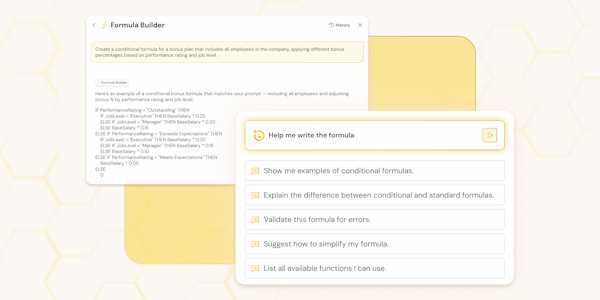
Beqom AI is the AI layer across beqom's compensation, pay equity and performance platform. beqom calls its approach Intentional AI: a set of specialist agents, anchored by a personal AI productivity partner, with humans kept in the loop for critical decisions.
Use cases
- Building calculations without formulas. Describe the formula you want, and the Formula Builder agent generates the calculation, mapping the right data fields and conditional logic.
- Running pay gap analysis. The Pay Gap Analyzer walks you through regression modeling and pinpoints the factors behind your unadjusted and adjusted pay gap.
- Checking raises for bias. The Bias-Checker spots differences in how raises have been attributed and highlights areas that need review.
- Setting new-hire pay. Comp Navigator generates pay suggestions for new hires, compares groups, adds benchmarks and visualizes proposed compensation using your existing models.
- Allocating raise budgets. A proprietary optimization algorithm distributes raises based on your priorities and constraints.
- Explaining pay differences. Pay Explainability helps HRBPs uncover and explain the key drivers behind pay differences.
- Getting cited answers. Knowledge Hive answers complex questions with cited summaries from beqom's knowledge base.
Key features
- Human-in-the-loop design: The AI flags potential bias and offers guidance, while people make the pay decision.
- Explainability-first: beqom positions its models as white-box and auditable rather than black-box outputs.
- Controllable AI: Users choose when and how AI assists.
- Security and compliance badges: ISO 27001, SOC 2 Type II, GDPR and an EU AI Act badge on the product page.
- HCM connectors: Built-in connectors for Workday, SAP SuccessFactors, Oracle and Salesforce.

%20(90).png)