




%20(94).png)


.svg)



Purpose-built compensation management software is designed around how comp actually works: bands, eligibility, merit matrices, budgets, approvals and multi-country rules
US pay transparency laws make every posted range public, so the pay decisions behind them have to hold up
CompportIQ, Compport's compensation intelligence layer, puts purpose-built AI agents on top of that foundation, working on your live data under your rules
Building this in-house means building the comp data layer, calculation engines, governance and upkeep, not just connecting an AI model
Pay is becoming public on both sides of the Atlantic. In the US, Virginia's pay transparency law took effect on July 1, 2026, making it one of 13 states that now require salary ranges in job postings, alongside California, Colorado and New York. In Europe, the deadline for member states to bring the EU Pay Transparency Directive into national law passed on June 7, 2026, and the first gender pay gap reports for larger employers are due from June 2027.
The rules differ by jurisdiction, but they ask employers for the same thing: pay you can explain. Ranges have to be posted in good faith, employees can ask how their pay is set, and gaps between people doing similar work have to be justified or fixed. Once a range is public, the decisions behind it have to hold up.
- Who sits where in the range, and why?
- Are people in similar roles paid similarly?
- What happens to your posted ranges after this year's merit cycle?
If the data behind those answers lives across an HRIS, a few spreadsheets and a lot of email, every question starts with exporting and reconciling before anyone can analyze anything. By the time the answer arrives, the decision it was meant to inform has often moved on.
That's the case for purpose-built compensation management software, and for an intelligence layer on top of it. This guide covers what purpose-built means, how it compares with the alternatives, what it looks like in practice with CompportIQ, and whether you should build or buy.
What is purpose-built compensation management software?
The word that matters is "purpose-built." A general HR system stores compensation in a single field on an employee record. A spreadsheet holds whatever you put in it. Purpose-built software understands what the numbers mean: that a 1.15 compa-ratio sits high in a band, that eligibility rules decide who's in the merit cycle, that a budget has to balance across departments, and that every change needs the right approver.
That foundation matters even more once AI enters the picture. An AI model on its own doesn't know your bands, matrices, or approval chains. Put it on top of a data export, and you get a chatbot that can describe numbers it doesn't understand. Put it on top of purpose-built comp software, and it can reason inside your actual rules.
That's how CompportIQ works. It's Compport's compensation intelligence layer, built on the platform that runs your comp cycle. Six purpose-built agents are live today, covering pay equity, benchmarking, comp planning, budget management, calibration, and analytics. An orchestration layer reads your request, routes it to the right agent, and works on your live data with the same permissions you already have.
Every number comes from tested calculation engines running on your data. The language model interprets the question, explains the result, and never generates a figure on its own. That split is what makes the answers usable in a comp decision.
Purpose-built software vs the alternatives
If your current setup is some mix of spreadsheets, your HRIS and general AI tools, here's how those compare with purpose-built comp software.
Spreadsheets are flexible but disconnected, and every version is a new risk. HRIS modules keep data in one place but are usually built around HR records rather than comp logic. General AI chatbots answer quickly, but they only see the file you give them and can't enforce who sees what. Purpose-built software is the only option that combines comp rules, live data, governance, and safe AI in one place.
Why your comp team needs a purpose-build compensation software now
Pay transparency puts every range on display
When ranges are posted, employees and candidates can see where they sit, and they'll ask about it. Your ranges, and the placement of every employee inside them, need to be defensible. That's hard to do when ranges live in one file and pay data lives in another. For a state-by-state view of what's required, see our guide to US pay transparency laws by state.
Merit budgets have to be targeted, not spread evenly
Differentiating pay by performance and market position means modeling more scenarios and checking each one for cost and equity impact. Doing that by hand limits the number of options you can realistically test before a cycle opens.
Leaders want answers on their own teams
If business leaders have to ask the comp team every time they want to see how their teams are paid against range and market, the comp team becomes a reporting desk.
AI raises the bar on governance
Comp data is some of the most sensitive data a company holds. Any AI that touches it needs to compute numbers rather than generate them, respect access rules, log every action, and keep a person in charge of decisions. Purpose-built software is designed for exactly that.
What purpose-built looks like in practice: Use cases with CompportIQ
Here's what changes when an intelligence layer is built into purpose-built AI-native comp software. Each use case below runs on CompportIQ, on your live data.
1. Spot pay-performance gaps before people leave
The problem
If you usually find out pay is off when a top performer resigns or comes back with a competing offer, the gap was there long before. Finding it earlier means pulling data from several systems and spending days in Excel, so the check tends to happen once a year, at cycle time.
.png)
How CompportIQ helps
Ask in plain English and get the answer in minutes, by department, any day of the year. CompportIQ flags high performers paid below their range and low performers paid above it, and shows the cost to fix.
Why it matters
You see the risk before it turns into a resignation. And because CompportIQ runs with each person's own access rights, business leaders can check their own teams without waiting on comp for the data.
2. Benchmark against your own market data
The problem
Benchmarking starts with matching your roles to survey jobs, and matching on title alone skews every percentile that follows.
How CompportIQ helps
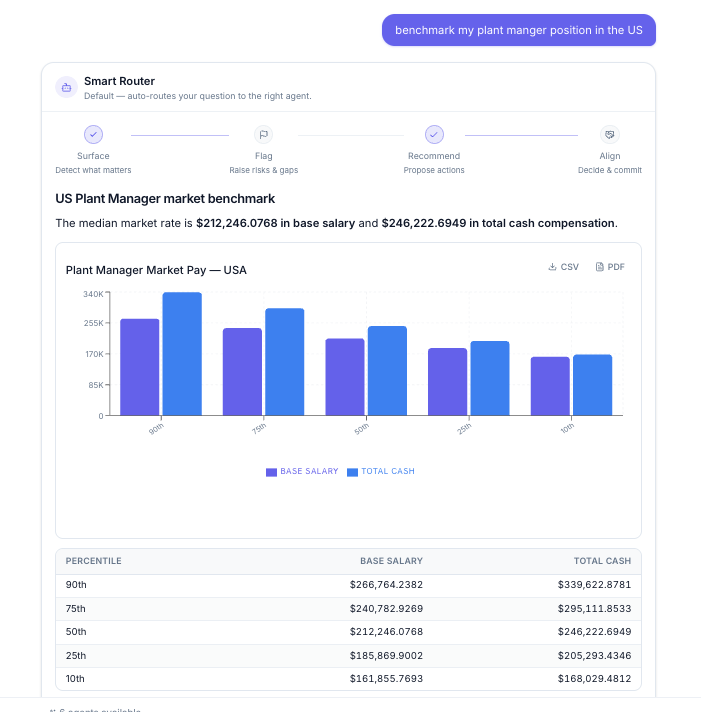
CompportIQ benchmarks against the market data you upload. Ask for a role benchmark in plain English and get base salary and total cash across percentiles. When matching roles, it looks at job scope and level rather than title alone, scores each match, and flags the ones that need a person to review.
Why it matters
Your team spends its time on edge cases rather than on every role, and every benchmark traces back to your own licensed data.
3. Harmonize job architecture after a merger or reorg
The problem
When two organizations come together, the same job title can mean different things, and different titles can mean the same job. Bringing two job architectures into one, then working out what it costs to make pay fair, can take weeks of analysis.
How CompportIQ helps
Load both job architectures and CompportIQ proposes one harmonized framework, matching roles by work, scope and level rather than title, with a confidence score on each mapping. Exceptions are flagged for your review, and the equity and cost-to-remediate analysis runs in the same pass.
Why it matters
You can tell leadership what Day 1 actually costs, and you stay in control of every mapping decision.
From pulling data to advising to shaping strategy
Put those use cases together and the comp team's role starts to shift. Less time goes into pulling and reconciling data. More goes into advising the business on pay decisions. And with the groundwork handled, there's room to work on strategy: pay philosophy, multi-year plans and the bigger questions that usually wait until the cycle is over.
That shift only works if the comp team stays in charge. CompportIQ informs, analyzes, simulates, and drafts. People decide.
Build vs buy: can you build purpose-built comp software yourself?
With AI models this accessible, it's fair to ask whether you could build this in-house. Connecting a model to your comp data is the quick part. The hard parts are everything around it.
You'd need a governed data layer that understands compensation, with tenant isolation and role-based access. You'd need deterministic engines for pay equity statistics and budget and calibration math, validated across real cycle designs and geographies. You'd need workflow integration so recommendations land where decisions are made. And you'd own evaluation, security hardening and model upkeep for as long as the tool exists.
An internal build still has to clear the same security review and works council scrutiny as any vendor, and internal efforts often end up as a chatbot rather than a data warehouse. Buying a purpose-built platform lets your AI talent focus on what's genuinely unique to your business, while your comp team gets a system that already reasons inside your comp architecture.
Where a purpose-built compensation layer like CompportIQ fits
CompportIQ is Compport's compensation intelligence layer. It sits on a purpose-built compensation platform that already runs merit, bonus, pay equity and total rewards cycles, so the intelligence works inside the bands, rules and approval chains you've configured.
Every number is computed by tested engines on your data. Agents run with the permissions of the person asking, enforced at the data layer. Your data never trains any model and stays tenant-isolated. Every action is logged, and no output changes a record without a named person approving it.

FAQs
What is purpose-built compensation management software?
It's software designed specifically for planning, analyzing, and governing pay. It models pay bands, eligibility rules, merit matrices, budgets and approval chains, and runs the comp cycle on live employee data.
How is it different from an HRIS compensation module?
HRIS modules store compensation information as part of the employee record and typically provide generic workflows. Purpose-built software is designed around comp logic itself, with built-in pay equity analysis, budget modeling, and approval chains configured to your comp model.
Can we use a general AI tool like ChatGPT for compensation analysis?
A general chatbot only sees the file you give it. It doesn't know your bands or rules, can't control who sees what, and its numbers aren't computed by tested engines. An intelligence layer like CompportIQ works on your live comp data under your rules and access controls.
Should we build our own compensation software or buy one?
You can build a demo quickly, but a defensible system needs a governed comp data layer, validated calculation engines, workflow integration and permanent maintenance, plus the same security and works-council review a vendor faces. A purpose-built platform already has those in place.
What can AI in compensation software do today?
With CompportIQ, it can flag pay-performance gaps, build merit matrices and budgets from a prompt, run pay equity analysis, harmonize job architectures and benchmark roles against your uploaded market data. Attrition prediction, promotion planning, and pay transparency checks are on the roadmap.
Does purpose-built comp software replace the comp team?
No. It handles the groundwork, so your team can spend more time advising the business and shaping comp strategy. Every recommendation still needs a person to review and approve it.
%20(93).png)
%20(92).png)