




%20(91).png)


.svg)



"AI" in comp software now covers everything from assistive features in market pricing to agentic systems that work inside the live cycle.
The five platforms compared here: CompportIQ, beqom AI, Payscale, Compose AI by Decusoft, and HRSoft Intelligence.
CompportIQ runs purpose-built agents on live cycle data, with every number computed by tested engines and every recommendation approved by a person.
Payscale's AI is strongest in market pricing and job matching. Decusoft and HRSoft suit heavy variable pay, LTI and carried interest.
Judge the AI by where its numbers come from and who approves the output, not by how many agents are on the product page.
Every compensation vendor has an AI story now. Open any product page, and you'll find agents, copilots, assistants or "intelligence" somewhere above the fold.
The problem is that the word covers very different things. Some platforms use AI to match jobs to survey data. Some put a chat window on top of reports. A few run agents that work inside the salary review itself, on live data, under the same rules and approvals as the rest of the cycle. Those differences decide whether AI saves your team weeks or adds one more output someone has to double-check.
This comparison looks at five platforms and what their AI actually does, so you know what to ask for in the demo.
You're reading this if
- Your comp team spends more time answering analysis requests than making decisions
- You're weighing merit budget models before the next salary review
- You're bringing two job structures together after a merger or reorg
- EU Pay Transparency Directive reporting is on your roadmap
- Leadership wants AI in comp, and IT and Legal want to know how it's governed
What is AI compensation management software, and do you actually need it?
You probably need it if a few of these sound familiar:
- Analytics requests queue behind one or two analysts
- Pay equity analysis happens once a year, or goes out to a consultant
- Merit budget scenarios get rebuilt in spreadsheets every cycle
- Pay transparency reporting deadlines are getting closer
Agentic AI vs AI agents: which one does comp actually need?
An AI agent does one job when you ask it to. It writes a formula, answers a question or drafts a report. It's useful, but you still decide what to ask, in what order, and you stitch the answers together yourself.
Agentic AI is a system that takes a whole request, works out the steps, and routes each one to the right specialized agent. Ask "what would it cost to close the pay gaps in engineering without breaking budget?" and it pulls the data, runs the equity analysis, models the options and explains the result.
For comp, agentic is the more useful model, with one condition. The numbers have to come from tested calculation engines, not from the language model, and a person has to approve anything that touches pay. Autonomy on its own isn't the goal. Getting to a defensible answer faster is.
How we evaluated the top AI compensation management platforms
Every platform here was assessed against the same six criteria:
- Where the numbers come from: Are figures computed by tested calculation engines on your data, or generated by the language model?
- Human approval: Does a named person approve before any output changes a pay record?
- Role-aware access and data privacy: Does the AI only see what the person asking can see, and is your data kept out of model training?
- Lifecycle coverage: Does the AI reach planning, pay equity, benchmarking, budgets and analytics, or just one of them?
- Explainability and audit trail: Can a manager see why a recommendation was made, and is every action logged?
- Fit with your existing HRIS and comp setup: Does it work with the systems and rules you already run?
Sources: vendor product pages and announcements, as of September 2026.
The 5 best AI compensation management platforms compared
1. CompportIQ
CompportIQ is the AI layer inside Compport, launched in August 2026. It's built on a platform that supports 1.5M+ users across 300+ customers in 37+ countries, and it works like a veteran comp analyst at your side.
Six purpose-built agents are live today: Pay Equity, Benchmarking, Comp Planner, Budget Management, Calibration, and Analytics. Each one works on your live data, inside the same rules, bands, and approval chains your cycle already runs on.
Use cases
- Harmonizing job architecture after a merger. Load both job architectures and CompportIQ proposes a single harmonized framework, matching roles by work, scope and level rather than title, with a confidence score on each mapping. Exceptions are flagged for your review. The equity and cost-to-remediate analysis runs in the same pass, so you can tell the CEO what Day 1 actually costs, not just what it might cost.
.png)
- Planning pay remediation. CompportIQ shows where internal parity breaks, where pay is out of line with the market, and who sits more than 10% outside their agreed position. It then models the options: fix the biggest gaps first, prioritize critical talent, or phase corrections over time, with a budget for each.
- Building the salary review model before the cycle opens. Put more weight on performance, move people below market faster, change the increase matrix or adjust the budget. Each scenario takes minutes, and each shows its cost and whether it strengthens pay for performance, improves market competitiveness or creates a pay equity concern.
- Catching pay equity risk mid-cycle. Check whether proposed increases would create or widen a gap, and which decisions to revisit before approvals close.
.png)
- Benchmarking on demand. Compare a team against your licensed market data on the spot, across functions and geographies, instead of commissioning a review that arrives after the decision.
.png)
- Answering analytics questions in plain English. Pay positioning, compa-ratio spreads and budget consumption come straight from live, role-scoped data, with no export and pivot required.
.png)
Key features
- Deterministic engine: Every number is computed by tested engines on your data, so the same inputs always produce the same auditable result. The language model explains results; it never generates figures.
- Explainable recommendations: Every recommendation shows its reasoning, and every assumption can be challenged and changed.
- Role-aware access: Agents run with the permissions of the person asking, enforced at the data layer. An HRBP sees their client group, a manager sees their team, and AI never widens access.
- Human approval: No output changes a record without a named person approving it.
- Full audit trail: Every action is logged with the user, timestamp and the basis behind the recommendation.
- Data privacy: Your data never trains any model and stays tenant-isolated.
- Certified security: ISO 27001 and SOC 2 Type II certified, with ISO 42001 certification for AI management in progress.
- Works with your HRIS: CompportIQ connects HR, performance, finance, market and compensation data, so every recommendation carries the full context. It runs on Compport's native integrations with Workday, SAP SuccessFactors, Oracle HCM, ADP, UKG and more, using standard API, SSO and integration flows.
2. Beqom AI
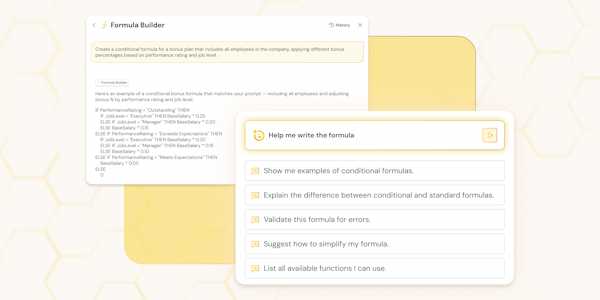
Beqom AI is the AI layer across beqom's compensation, pay equity and performance platform. Beqom calls its approach Intentional AI: a set of specialist agents, anchored by a personal AI productivity partner, with humans kept in the loop for critical decisions.
Use cases
- Building calculations without formulas. Describe the formula you want, and the Formula Builder agent generates the calculation, mapping the right data fields and conditional logic.
- Running pay gap analysis. The Pay Gap Analyzer walks you through regression modeling and pinpoints the factors behind your unadjusted and adjusted pay gap.
- Allocating raise budgets. A proprietary optimization algorithm distributes raises based on your priorities and constraints.
Key features
- Explainability-first: beqom positions its models as white-box and auditable rather than black-box outputs.
- Controllable AI: Users choose when and how AI assists.
- Security and compliance badges: ISO 27001, SOC 2 Type II, GDPR and an EU AI Act badge on the product page.
3. Payscale Ascent
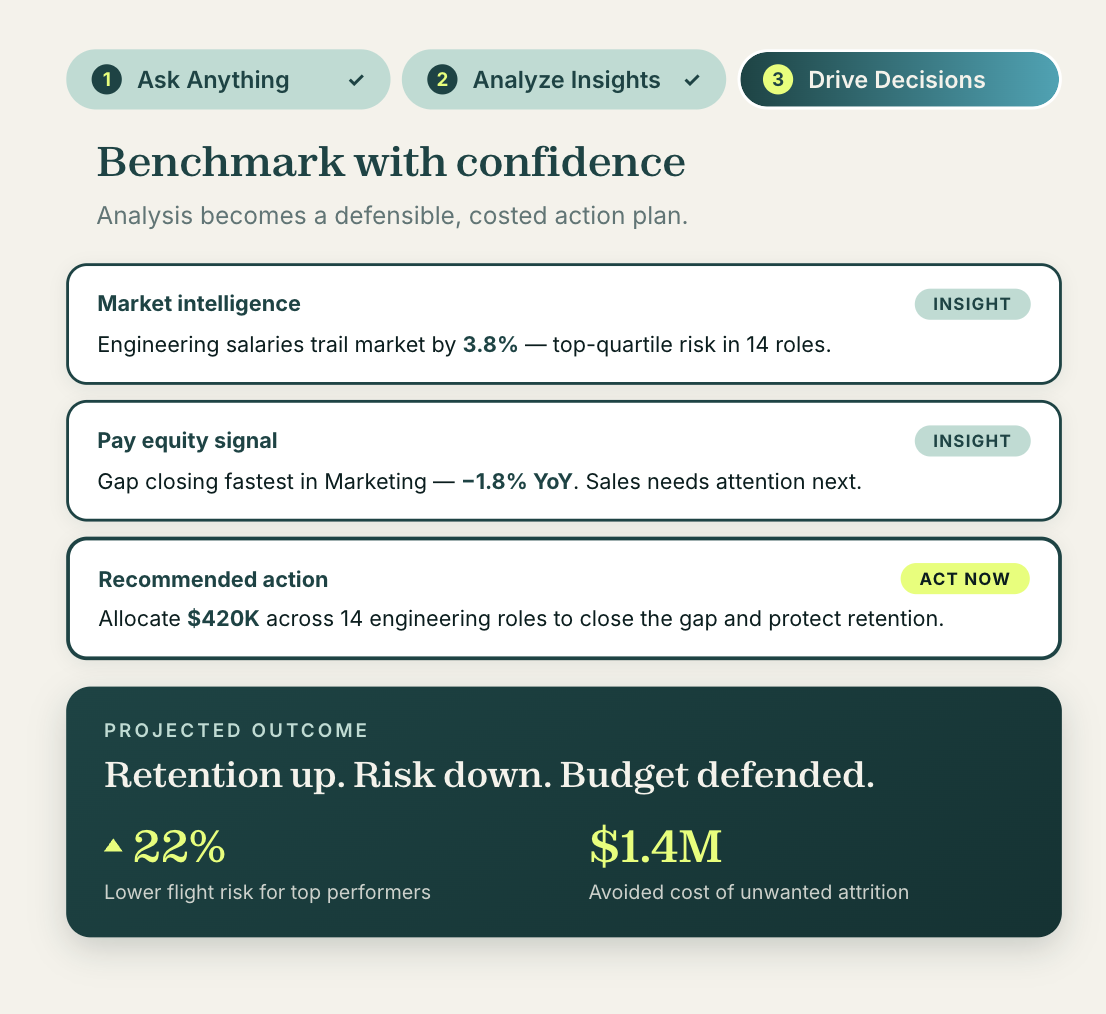
Payscale Ascent brings market data, purpose-built AI and workflows into one system for pricing roles and building ranges, and newer releases extend AI into reporting.
Use cases
- Matching roles to benchmarks. Purpose-built LLMs analyze your job architecture, skills data and Peer benchmarks to recommend pay ranges with confidence scores.
- Building reports on demand. It creates custom reports across pay, equity, performance and market data.
- Searching in plain language. Type a role description and Payscale maps it to the right benchmark role.
Key features
- Connected workflows: Pricing recommendations flow into offer, planning and equity workflows.
- AI-enhanced data: Modeled Calculated Cuts fill gaps where traditional survey data doesn't exist.
- HR-reported Peer data: A continuously refreshed peer network sits underneath the AI recommendations.
4. Compose AI by Decusoft
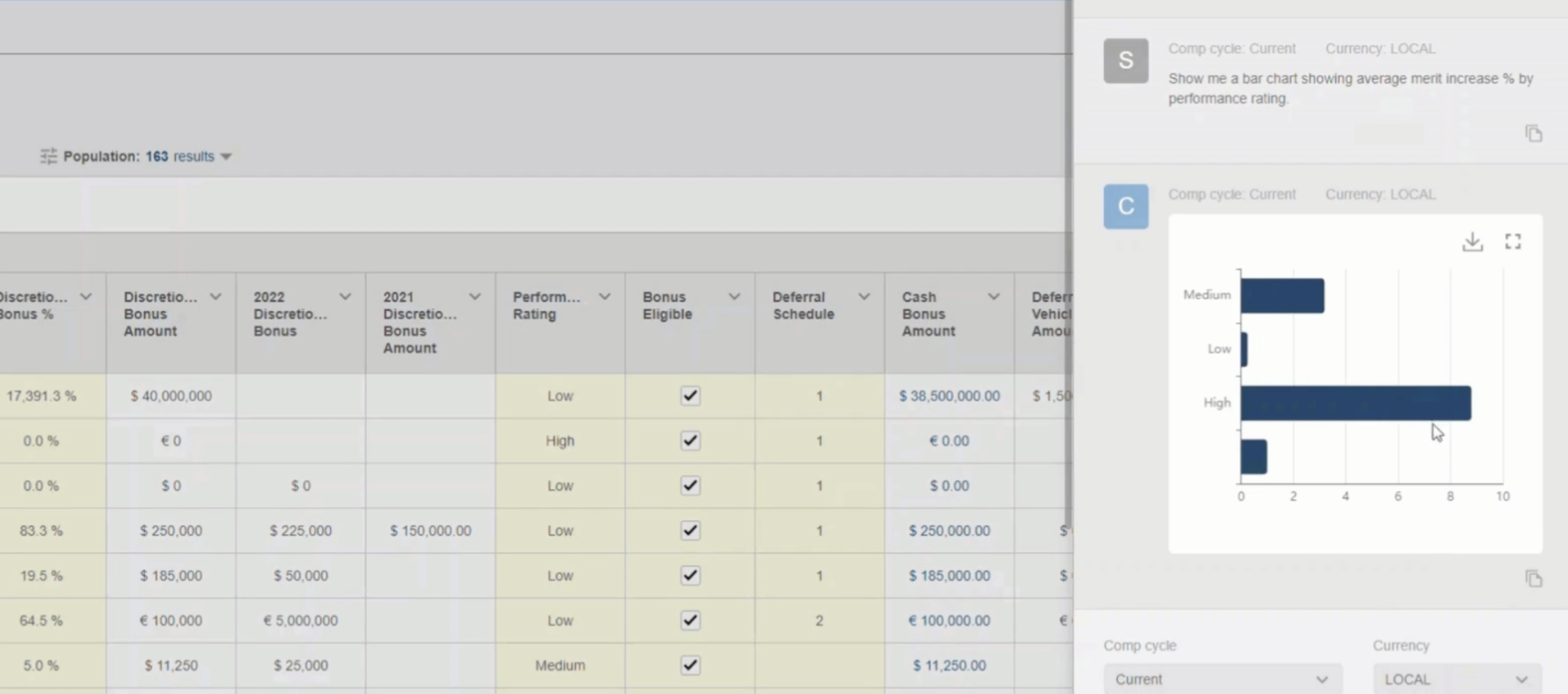
Compose AI is Decusoft's AI layer inside Compose, its compensation planning and variable pay platform.
Use cases
- Asking questions of comp data. Compose Insights lets HR and finance leaders ask plain-language questions to surface pay equity analyses, model budget scenarios, identify outliers and generate ad hoc reports.
- Modeling future pay decisions. Predictive Compensation models what compensation decisions will mean before they're made.
- Generating letters and statements. Compose automates employee communication letters and total rewards statements.
Key features
- Secure environment: All AI data interactions run inside Decusoft's SOC 2 Type II environment, with no data shared with external sources or other Compose users.
- No-code configuration: Business users configure the system themselves, including multi-currency planning with a consolidated budget view.
- Works alongside your HCM: Compose can replace spreadsheets or run alongside existing HCM platform.
5. HRSoft Intelligence
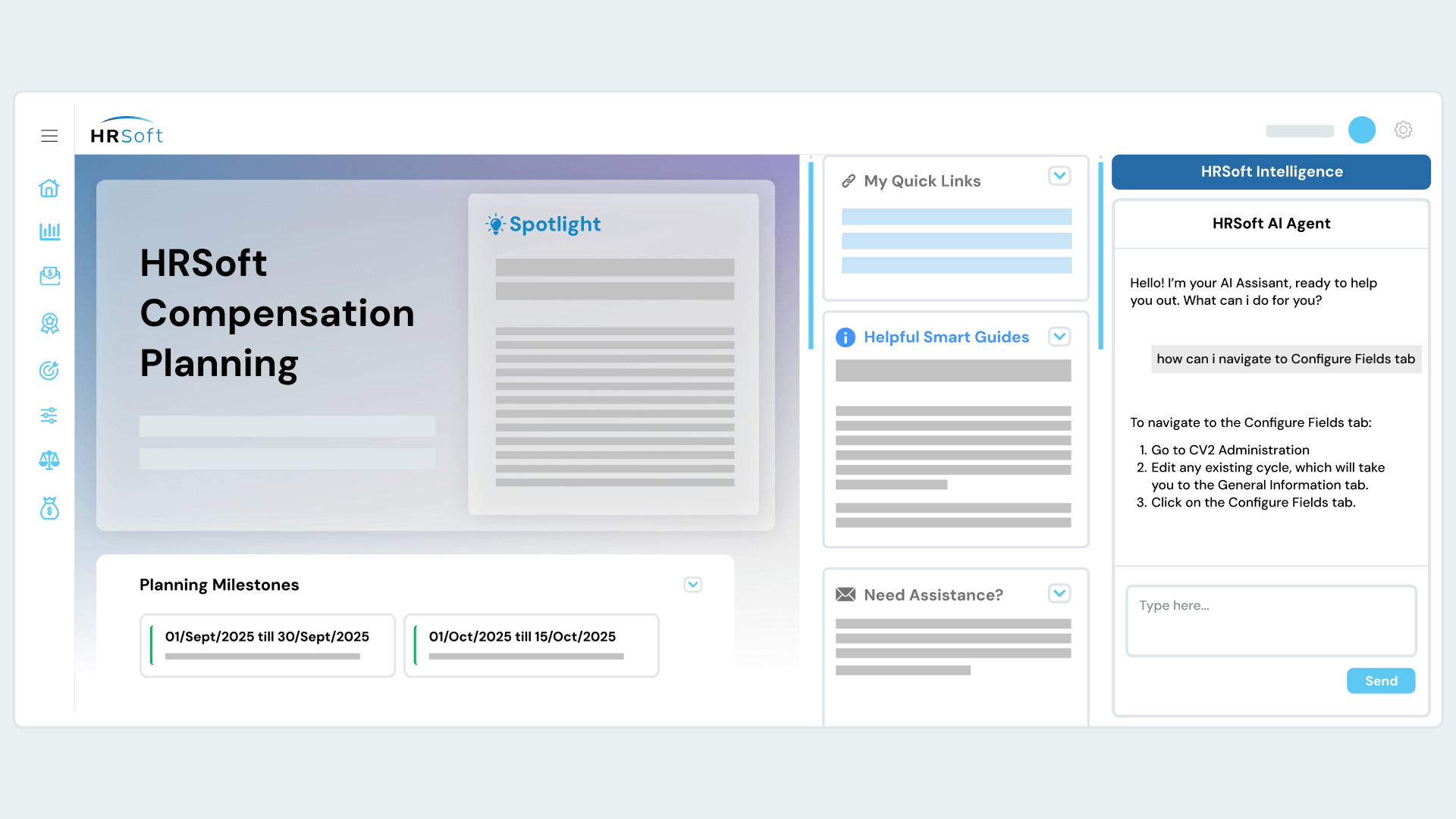
HRSoft Intelligence is the AI platform HRSoft on top of its compensation lifecycle software.
Use cases
- Cleaning data. HRSoft Intelligence cleans compensation data before cycles launch.
- Getting compensation recommendations. The platform provides recommendations with the reasoning behind each one.
- Self-service answers. Conversational self-service for HR teams working in the platform.
Key features
- Explainable AI: Every recommendation shows the reasoning behind it.
- Tiered adoption: A services model that ranges from chatbot-assisted configuration to predictive insights, so teams adopt AI at their own pace.
- Zero-code framework: An AI-first metadata orchestration framework with built-in security and GDPR compliance.
Which AI compensation software is right for your company size?
Company size changes what you actually need from AI in comp. It shifts how much data you're working with, how complex your cycles are, and how much governance your IT and Legal teams will expect.
Under 500 employees
Comp usually sits with one or two people, and there's often a single annual cycle. The biggest need is market pricing and pay range building. A lighter, pricing-focused tool like Payscale can cover that well.
500 to 5,000 employees
Cycles now span business units, managers, and often more than one country. Merit budget scenarios, pay equity checks, and analytics requests start piling up faster than a small comp team can answer them. This is where CompportIQ fits. Its agents model scenarios, check equity, and answer questions on live cycle data, inside the bands, rules, and approval chains you already run.
5,000+ employees, multi-country
At this scale, governance matters as much as speed. You need role-aware access, human approval before any record changes, a full audit trail, and pay transparency reporting across jurisdictions. CompportIQ is built for this. It runs on a platform that supports 1.5M+ users across 37+ countries.
What features should AI compensation management software actually have?
A clean interface and a long agent list don't tell you much. These are the capabilities that decide whether AI makes your pay decisions faster and more defensible, or just adds another output to check.
Numbers computed on your data, not generated
Every figure, from a pay gap to a budget position, should come from tested calculation engines running on your data. The language model should explain the result, not produce it. Ask the vendor where each number comes from.
Access scoped to the person asking
An HRBP should only see their client group, and a manager only their team. That scoping needs to be enforced at the data layer, not by instructions in a prompt.
Human approval before anything changes
AI should recommend. A named person should approve before any output changes a pay record, and that approval should be logged.
A reasoning trail a manager can defend
Every recommendation should show which factors, rules, and data drove it. If a manager can't explain it to an employee, it won't hold up in an appeal or a regulator's review.
No training on your data
Your compensation data should never be used to train any model, yours or a third party's, and should remain isolated from other customers' data. Get it in writing.
Statistically sound pay equity analysis
With EU Pay Transparency Directive reporting and US state laws expanding, pay equity analysis needs documented, reproducible statistical methods that a third-party expert could review.
Clear labeling of what is live and what is roadmap
AI product pages move fast. Ask the vendor to show each capability working on your data in the demo, and to label anything still on the roadmap.
CompportIQ fits when AI has to work inside the rules you already run
Every platform in this list has real AI capability. The difference is where that AI works and how much you can trust what it gives you.
CompportIQ, built on Compport, works inside the same platform that runs your cycle, on live data, under your bands, policies and approval chains. Every number is computed, every recommendation is explained, and a person makes the final call. That's comp you can defend.

FAQs
What is the best AI compensation management software in 2026?
It depends on where you need AI. CompportIQ suits enterprises that want agents working on live cycle data with human approval built in. Payscale's AI leads on market pricing and job matching, and Compose AI by Decusoft and HRSoft Intelligence suit heavy variable pay and carried interest.
What's the difference between agentic AI and AI agents in compensation software?
An AI agent handles one task when asked, such as writing a formula or answering a question. Agentic AI takes a whole request, plans the steps and routes each one to the right specialized agent. CompportIQ uses an agentic model, with every number computed by tested engines and a person approving the output.
Can AI compensation software work with Workday, SAP SuccessFactors or our current HRIS?
Yes, all five platforms here connect to major HRIS systems. CompportIQ runs on Compport, which integrates with Workday, SAP SuccessFactors, Oracle HCM, ADP and UKG. beqom offers built-in connectors for Workday, SAP SuccessFactors and Oracle.
Will AI make pay decisions without a human approving them?
It shouldn't. In CompportIQ, no output changes a pay record without a named person approving it, and every action is logged. beqom also keeps humans in the loop, so ask any vendor to show exactly where approvals sit in the demo.
Is our compensation data used to train the AI?
It depends on the vendor, so get it in writing. CompportIQ never uses customer data to train any model and keeps each customer's data isolated. Decusoft states that Compose AI data stays in its SOC 2 Type II environment with no sharing outside it.
Can AI compensation software help with EU Pay Transparency Directive compliance?
Yes, if its pay equity analysis is statistically sound and explainable. CompportIQ's Pay Equity agent works on live cycle data, so gaps surface before approvals close rather than after. beqom's Pay Gap Analyzer also walks teams through adjusted and unadjusted gap analysis.

%20(90).png)