

%20(64).png)


.svg)



Decusoft's Compose has real strengths. It's configurable, it handles complex comp plans that most HCM modules won't touch, and users consistently praise the service team.
So why are you reading this?
Probably because something broke mid-cycle, and fixing it wasn't in your hands. Or because your team asked for a report and the answer was "we can't build that here." Or because the documentation just... wasn't there when you needed it.
One verified reviewer on Gartner Peer Insights put it plainly: "We felt pushed to enter our data prematurely in the implementation process which led us to having data that was not the best starting point in our instance of Compose. We learned the hard way that there is no way for customers to delete a data upload themselves - a support ticket has to be entered and you have to wait for a mass deletion.."
If you're evaluating what else is out there, this guide covers five alternatives worth a serious look.
Why do Decusoft users look for alternatives?
We reviewed G2, Capterra, and Gartner Peer Insights to find out what's actually frustrating Decusoft users. Here's what kept coming up.
Reporting and analytics gaps
Comp teams run on data. But when the reports you need don't exist natively and building them requires a workaround, you're spending time on infrastructure instead of strategy. That's the gap Decusoft users keep running into.
“While we had standard reports, we would have liked to have the ability to create custom reporting based on company needs.” - A verified enterprise user on G2
Slow calculations and performance hits
Formula-heavy comp plans are standard for any organization with layered bonus logic. When a recalculation touches every formula field regardless of what changed, the whole system slows down, and fields you've already locked get recalculated anyway.
“Calculation processing can be a bit slow at times. Additionally, when a calculation kicks off, it recalculates all formula driven fields which impacts system performance and may recalculate fields that have previously been overridden.” - A verified user on G2
Weak documentation and training
This one compounds every other pain point. When the tool is complex and the docs aren't there, your team figures it out alone or leans on the vendor for things they should be able to do independently.
“The biggest thing we disliked was the lack of training resources available to both us and the end user. Decusoft is quite frankly pretty weak at product documentation for Compose.” - An HR Analyst on Gartner Peer Insights
For lean comp teams, this is beyond frustrating. It's hours. And during peak cycle season, those hours don't exist.
Cumbersome imports and mid-cycle admin friction
Setting up a cycle should be something your team controls. When routine tasks like importing data or fixing an upload error require vendor intervention, your timeline isn't really yours.
“Imports and setting up cycle security is cumbersome and takes more time than expected.” - A Global HRIS Admin and Payroll Manager on Gartner Peer Insights
Some reviewers also flagged that there's no way for customers to delete a data upload themselves in Decusoft's Compose. You have to file a support ticket and wait. For a team running a live cycle, that kind of dependency is a real problem.
Bugs and instability after version upgrades
A new version should make things better. When it introduces bugs mid-cycle, it makes things worse at exactly the wrong moment.
“New version 11 is still working out the 'kinks". We were one of the first clients on version 11, and we found multiple bugs.” - An AVP, HR Systems and Data on G2
Being an early adopter on a new version is a risk most comp teams can't afford, especially when cycles have hard deadlines.
5 Best Decusoft alternatives for comp teams in 2026
1. Compport

Compport is a comprehensive compensation management platform serving 300+ companies and managing compensation for over 1.5 million employees globally. Where Decusoft requires vendor intervention for mid-cycle changes, and documentation is thin on the ground, Compport puts configuration directly in the hands of comp administrators. No support tickets. No consultant calls. No waiting.
What it covers
- Compensation Planning: merit cycles, ad-hoc adjustments, and market-based corrections with a self-serve rule engine
- Short-term Incentives: variable pay and incentive design with scenario modeling
- Long Term Incentives: automated vesting and payout tracking in the same workflow as merit and bonus
- Sales Incentives Planning: commission automation alongside HR comp, no separate ICM tool needed
- Pay Equity Management: ML-powered gap analysis with continuous monitoring
- Total Rewards Statements: personalized statements configurable by role, level, location, and tenure
- HR Analytics: 200+ built-in reports and dashboards, no custom development required
- Candidate Offer Module: market-aligned offer creation within the same platform
Pros
- Survey-style interface that managers actually understand. Most onboard in under 20 minutes, no training sessions required
- Implementation in 6 to 8 weeks with white-glove support throughout, compared to the months-long timelines of legacy platforms
- Support turnaround as fast as 4 hours. Users on G2 and Gartner consistently name responsiveness as the standout differentiator
- 200+ pre-built interactive reports that answer stakeholder questions before they ask
- Full self-service configuration. Mid-cycle rule changes, eligibility updates, and budget adjustments, all without calling a vendor
Cons
- Newer platform compared to legacy competitors, smaller review base on G2 and Capterra
Integrations
Native bi-directional API with Workday, SAP SuccessFactors, Oracle HCM, ADP, Darwinbox, UKG, and BambooHR. Employee data flows in, planning and approvals happen in Compport, and approved changes sync back. No manual reconciliation.
2. HRSoft
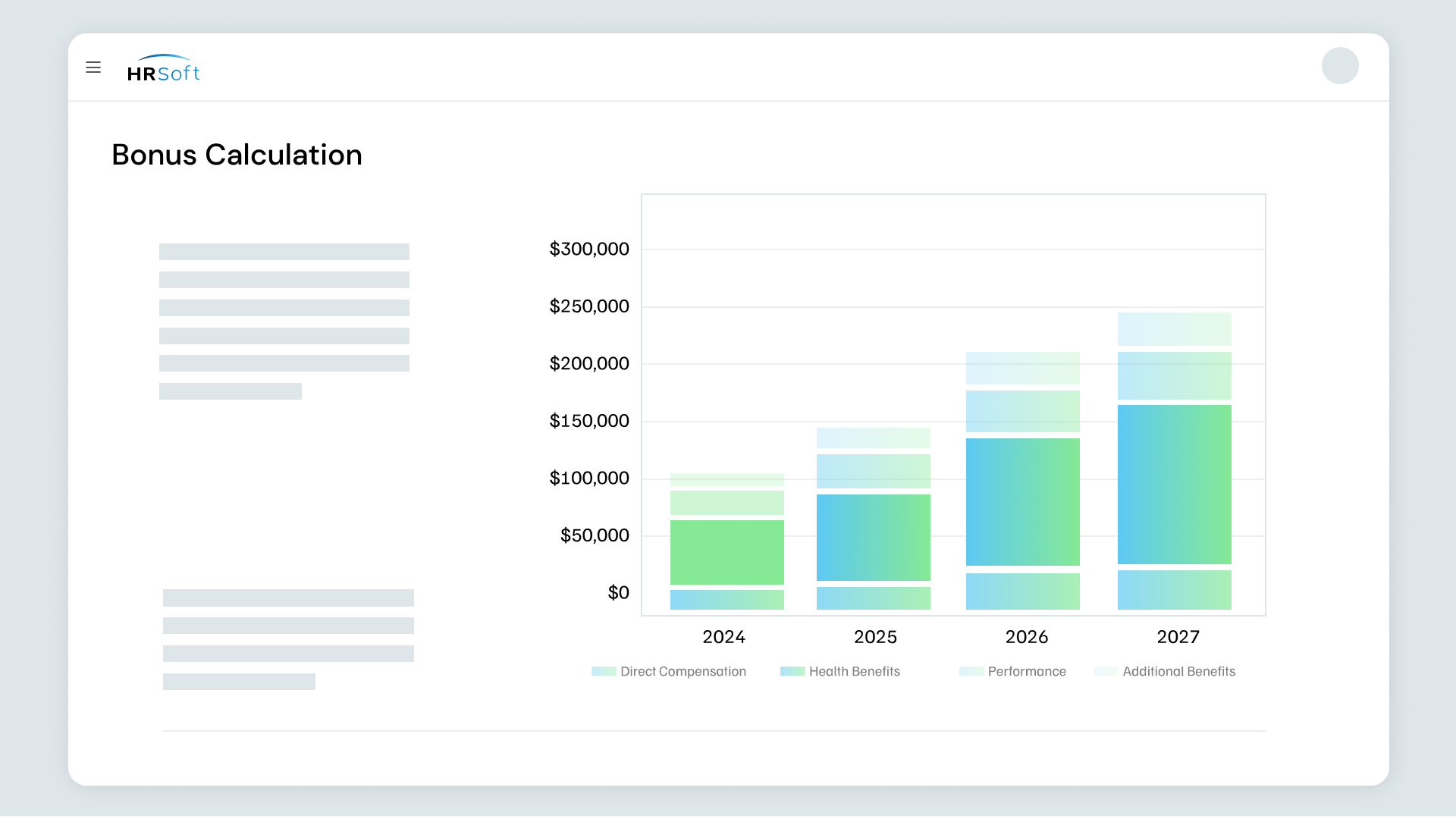
HRSoft is a compensation lifecycle platform well-established in financial services, insurance, and healthcare, where audit trails and governance controls are non-negotiable.
What it covers
Merit and bonus planning, LTI, carried interest, deferred comp, total rewards communications, and variable pay.
Pros
- Strong audit trails and governance controls for regulated industries
- Budget distribution, holdback management, and proration logic handle complex scenarios well
- The implementation team is consistently praised by customers
Cons
- Planner and admin UI feels dated; multiple reviewers describe it as less intuitive than newer platforms
- Performance slowdowns during peak usage periods are reported on G2 and Capterra
- Analytics capabilities are limited relative to the platform's overall depth
- HRIS data management requires manual effort; no ongoing API sync is reported by several users
Integrations
Marketed as native with major HRIS platforms. Verify whether the integration is API-based or file-based during your evaluation.
3. Beqom
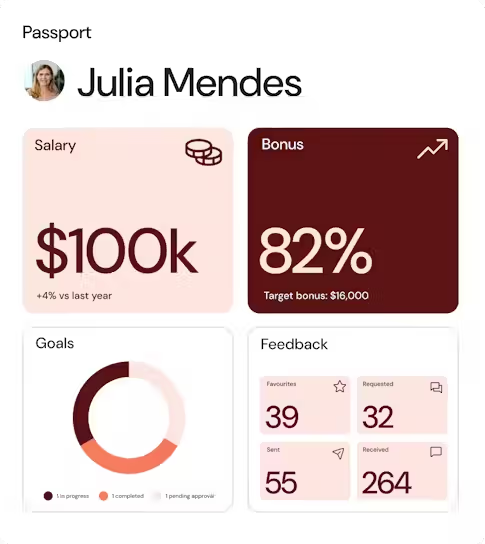
Beqom is an enterprise compensation platform that handles HR compensation and sales performance management in a single engine. It's built for large multinationals with complex, multi-country comp structures.
What it covers
Merit, bonus, LTI, deferred comp, sales performance management, and pay equity analytics via PayAnalytics.
Pros
- Handles complex multinational comp structures and large datasets
- Combines HR comp and sales performance management on one platform
- Strong simulation and scenario planning tools
Cons
- High flexibility comes with a cost: over-customization frequently leads to maintenance difficulties and system regressions
- Implementations can run up to 9 months, one of the longer timelines in this category
- Non-standard support requests take longer to resolve, flagged consistently on G2
- Recurring system issues reported during active comp cycles
Integrations
Integrates with major HCM platforms via Flexspring and Modulus connectors.
4. Payfactors by Payscale
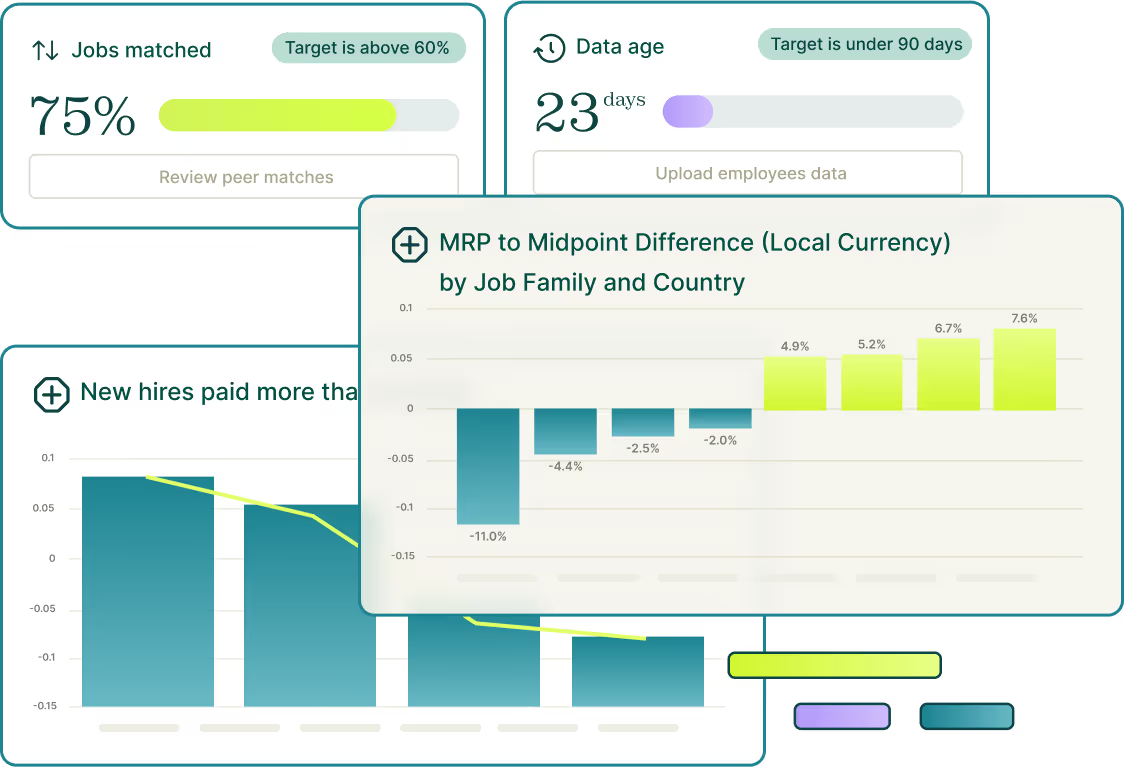
Payscale operates three distinct products: Payfactors for mid-market comp management, MarketPay for enterprise survey aggregation, and Paycycle for merit cycle planning. The data engine is the headline. Comp planning is secondary, and it's worth going in with that expectation set.
What it covers
Survey aggregation across hundreds of third-party sources, pay gap reporting, and Paycycle as a merit planning layer.
Pros
- Deep US benchmarking with multiple data lenses, including Peer crowdsourced data alongside third-party surveys
- Good fit for lean comp teams where market data is the primary gap
- Paycycle customers report meaningful cycle time reduction
Cons
- Global data coverage is a documented gap; reviewers cite limited country coverage outside the US
- Paycycle is newer with a thinner implementation track record
- Complex bonus logic and LTI are not core strengths
- Manual data structure setup is reported as time-consuming
Integrations
Native API integration with Workday HCM via Payfactors.
5. Aeqium
%20(90).png)
%20(85).png)
%20(89).png)