



%20(96).png)


.svg)



AI pay equity software ranges from audit tools with AI guidance to agentic systems that check pay equity inside the live comp cycle.
The five tools compared here: CompportIQ, Syndio, Trusaic, Pave and Beqom.
CompportIQ runs pay equity analysis on live data, on the same platform that runs your cycle, with reproducible statistics and a person approving every decision.
Check whether a vendor's AI is live today, and whether its AI and pay equity were built in-house or acquired.
Pay equity has moved from an annual exercise to a standing obligation. In the US, more than a dozen states now require salary ranges in job postings, and several also expect employers to report pay data or explain how pay is set. In Europe, the deadline for member states to bring the EU Pay Transparency Directive into national law passed in June 2026, with implementation still uneven across countries, and the first gender pay gap reports for larger employers are due from June 2027.
On both sides of the Atlantic, the expectation is the same: find gaps between people doing similar work, explain them or fix them, and be able to show your reasoning. A study that lands once a year doesn't keep up with that, which is why more pay equity vendors now lead with AI.
The trouble is that AI pay equity software means different things depending on the vendor. Some tools use AI to guide an audit. Some flag risks inside market pricing. A few run pay equity checks during the live comp cycle, so any gap is caught before the increase that caused it is approved. This comparison looks at five tools and what their AI actually does.
You're reading this if
- Your pay equity analysis happens once a year, or through an outside consultant
- You need to explain pay gaps to auditors, regulators, or leadership
- US state pay transparency laws or the EU Pay Transparency Directive apply to you
- You want to catch gaps during the merit cycle, not after it closes
- You're comparing AI pay equity software and want to know what's live today
What is AI pay equity software, and do you actually need it?
You probably need it if a few of these sound familiar:
- Each pay equity study means exporting data and waiting weeks for results
- Gaps show up after the merit cycle, when fixing them means another round of approvals
- You can't easily explain which factors drive a gap
- Remediation budgets are estimated rather than modeled
AI pay equity audits vs pay equity checks inside the cycle
A pay equity audit tells you a gap exists. It's essential, and every tool in this list supports some form of it. But an audit looks backward: by the time it runs, the decisions that created the gap have already been approved.
Checks inside the cycle work the other way. When pay equity analysis runs on the same data and platform as merit planning, you can see whether proposed increases would create or widen a gap before it's too late to change them. That's the difference to look for when you compare pay equity audit software with AI. For a broader look at the category, see our guide to the best pay equity software.
How we evaluated the top AI pay equity software
Every tool here was assessed against the same six criteria:
- Statistical method: Does the analysis use documented, reproducible methods with declared control factors?
- AI status: Is the AI live today, or still in development?
- In-cycle checks: Can pay equity be checked while pay decisions are being made?
- How it was built: Were the AI and pay equity capabilities built on a single platform, or acquired?
- Explainability and audit-ready output: Can you show auditors and leadership how a result was reached?
- Fit with your HRIS and comp setup: Does it work with the systems and rules you already run?
Sources: vendor product pages, announcements and news coverage, as of October 2026.
The 5 best AI pay equity software compared
1. CompportIQ
CompportIQ is Compport's compensation intelligence layer. Pay Equity is one of six purpose-built agents live today, alongside Benchmarking, Comp Planner, Budget Management, Calibration and Analytics. All of them run on the same platform that runs your merit, bonus, and total rewards cycles, which already supports 1.5M+ users across 300+ customers in 37+ countries.
That matters for pay equity. The analysis works on your live data, inside your bands, rules, and approval chains, so there's nothing to export and nothing to re-import.
.png)
Use cases
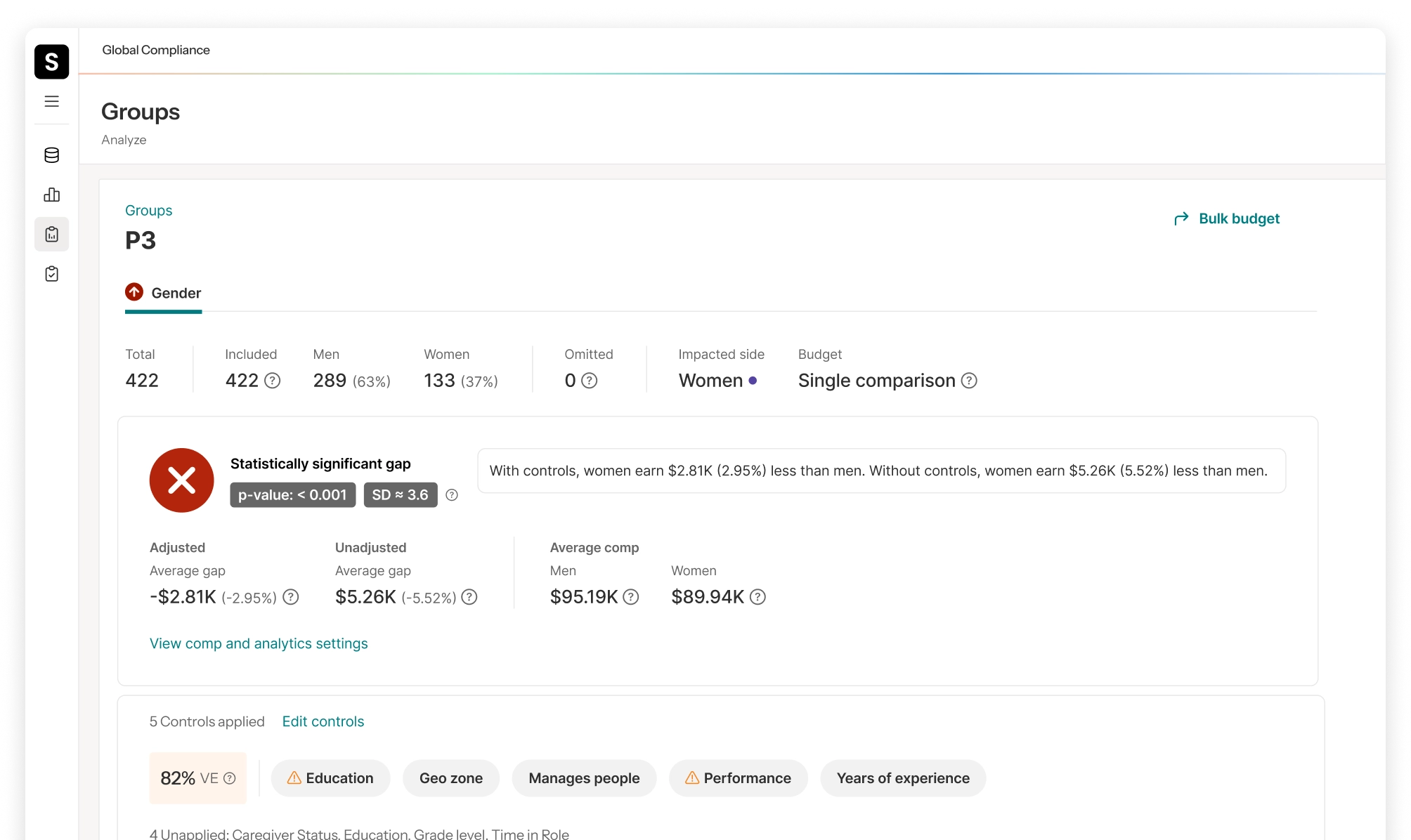
- Running pay equity audits on live data. See the adjusted gap, whether it's statistically significant, which cohorts are affected, how many employees are at risk, and whether the gap crosses a threshold such as ±5%. Representation by level shows where people sit in the hierarchy, a gap pay numbers alone don't show.
- Separating real findings from data issues. When a cohort's gap looks implausibly large, CompportIQ flags it for a reasonability check as a likely uncontrolled factor or data issue, instead of reporting it as a finding.
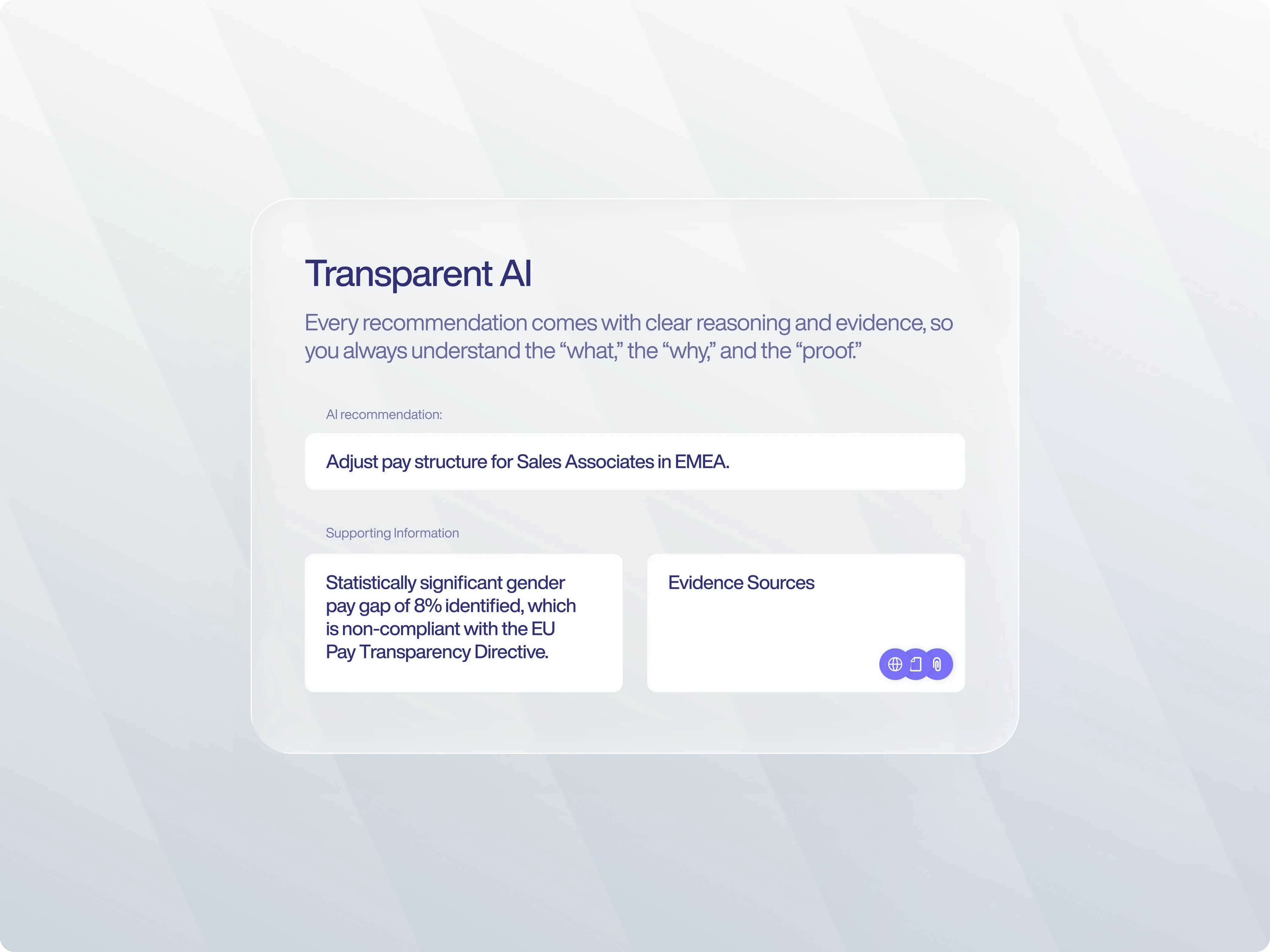
- Explaining what's driving a gap. Drill into the factors behind a result, then export an auditor packet for review.
- Catching pay equity risk mid-cycle. Check whether proposed increases would create or widen a gap, and which decisions to revisit before approvals close.
- Spotting pay-performance gaps. Ask, by department, for high performers paid below the midpoint of their range and low performers paid above the range max, with the cost to fix.
- Closing gaps through the merit plan. Describe the goal, such as closing pay gaps for an acquired workforce over three years within the same budget, and CompportIQ builds the merit matrix and budget with the cost for each year. The comp leader reviews and approves everything.
- Costing remediation after a merger. Harmonize two job architectures and run the equity and cost-to-remediate analysis in the same pass, so you know what Day 1 actually costs.
Key features
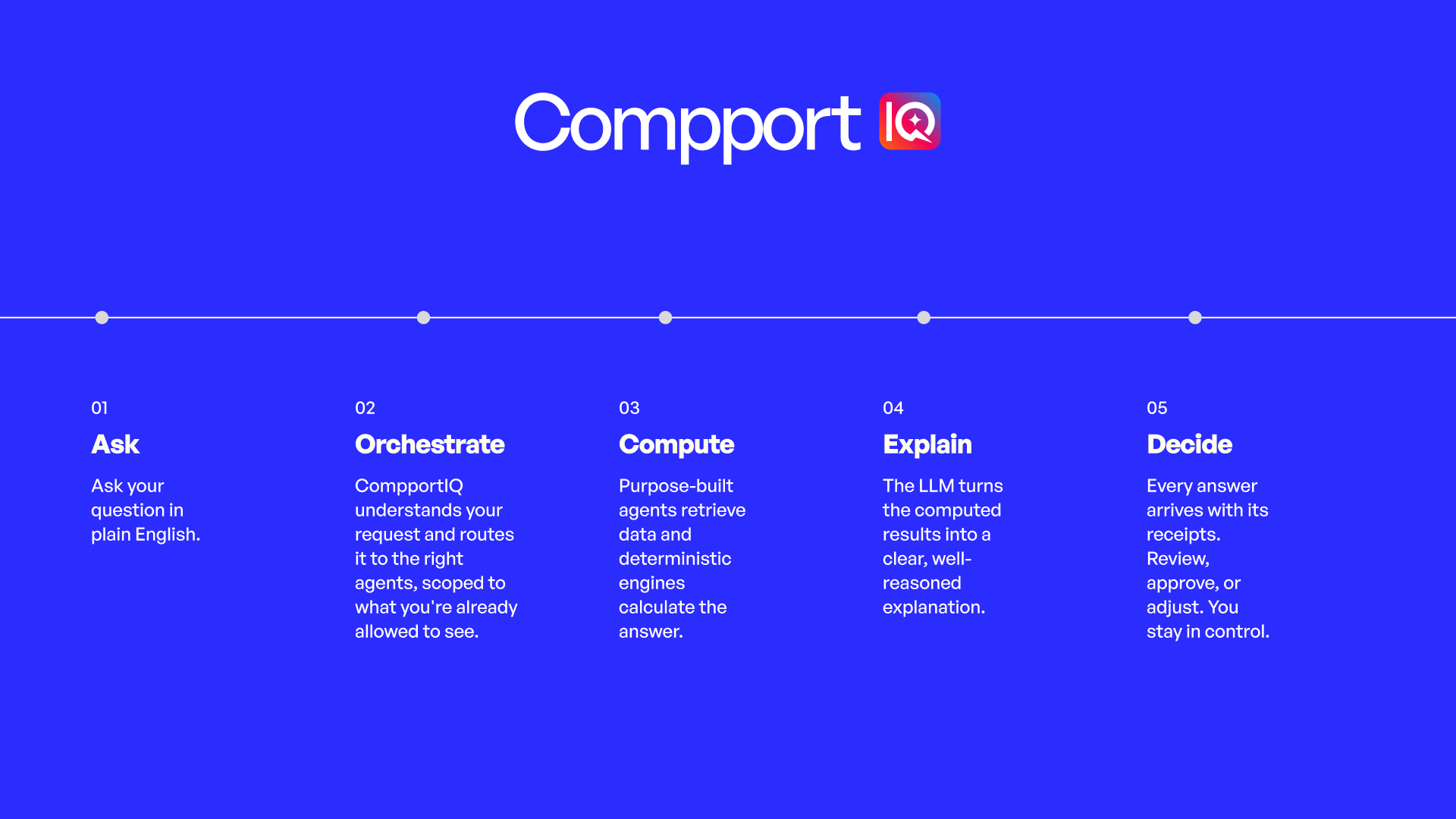
- Deterministic statistical engine: Pay equity figures come from coded, tested calculations such as regression with declared control factors. The same inputs always produce the same result, and an outside expert can review and reproduce it.
- Numbers computed, not generated: The language model interprets your question and explains the result. It never produces a figure that didn't come from a calculation on your data.
- Bias kept out of the logic: Protected attributes aren't features of recommendation logic, and the Pay Equity agent exists to detect bias already present in historical data.
- Role-aware access: Agents run with the permissions of the person asking, enforced at the data layer. An HRBP sees their client group, a manager sees their team.
- Human approval and full audit trail: Recommendations land in your existing approval workflow, and every action is logged with the user, timestamp, and basis behind it.
- No training on your data: Your data never trains any model, ours or a third party's, and stays tenant-isolated.
- One platform: Pay equity, merit planning, budgets and approvals are built on Compport, with nothing acquired or bolted on.
- Works with your HRIS: CompportIQ pulls HR, performance, finance, market and compensation data together, so every pay equity analysis has the full picture. It uses Compport’s native integrations with Workday, SAP SuccessFactors, Oracle HCM, ADP, UKG and more, connected through standard API, SSO and integration flows.
2. Syndio
Syndio built its business on pay equity analysis and now positions itself around what it calls Decision Intelligence for Pay. Its AI, Syndi, evaluates pay decisions against internal equity, market data, policy rules, and compliance requirements.
Use cases
- Syndio's core platform runs ongoing pay equity analysis and risk alerts.
- Syndi delivers pay recommendations and equity checks inside tools such as Workday, Slack, and Microsoft Teams.
- Syndio covers pay transparency reporting, including the EU Pay Transparency Directive.
Key features
- Syndio describes Syndi as combining adaptive AI with deterministic rules that enforce your pay philosophy.
- Recommendations appear in the workflows teams already use.
- Ranges, bands, policies and equity targets are configured in the platform.
3. Trusaic
PayParity is Trusaic’s pay equity product. It analyzes compensation data from your HRIS to surface statistically significant pay gaps and models remediation through its ROSA engine. Trusaic is also building a dedicated AI layer, Trusaic AI, on top of its pay equity and pay transparency methodology.
Use cases
- Intersectional analysis across gender, race, age, disability, and more in a single statistical model
- Pay Decisions generates offers from inside Workday, and Salary Range Finder builds ranges designed to prevent new inequities.
- Support for US state reporting and the EU Pay Transparency Directive.
Key features
- Trusaic runs tests on workforce data to catch issues before analysis.
- Integrations with systems such as Workday, UKG, SAP, and ADP
- Trusaic AI is still in development, and its Responsible AI page describes these features as planned.
4. Pave
Pave is an AI compensation platform built on real-time market data from connected HRIS, ATS, and equity systems. Its Pave Agent, also called Paige, works as an AI compensation analyst across pricing and planning.

Use cases
- The Pave Agent proactively identifies pay equity issues, compression, and retention risks.
- It highlights where pay is drifting outside ranges.
- Benchmarks and analysis through a chat interface.
Key features
- Benchmarks sourced through live system connections.
- Analysis runs inside market pricing and comp planning.
5. Beqom
Beqom pairs its compensation and performance platform with pay equity and transparency tools, under an approach it calls Intentional AI.

Use cases
- Running pay gap analysis. The Pay Gap Analyzer agent walks users through regression modeling of adjusted and unadjusted gaps.
- Checking for bias. A Bias-Checker agent reviews pay decisions for bias patterns.
- Modeling remediation. beqom's comp modeling estimates the budget impact of remediation scenarios.
Key features
- Human in the loop: beqom keeps people in control of critical decisions.
- Explainability-first positioning: beqom describes its models as auditable rather than black-box.
%20(95).png)
%20(94).png)