




%2520(74).png)


.svg)



Once you have tiered accelerators, multi-currency payouts, or finance spending a full day reconciling commissions, dedicated software stops being optional
The top eight platforms in 2026 are Compport, Qobra, CaptivateIQ, Salesforce Spiff, Everstage, QuotaPath, Xactly Incent, Performio, and Forma.ai
Compport is built for enterprises that want sales incentives running on the same platform as merit, bonus, and total rewards, with no separate system to reconcile
Spiff suits Salesforce-native orgs, QuotaPath fits SMBs moving off spreadsheets, Xactly suits complex enterprise structures, Forma.ai leads on AI-driven payout forecasting, and Qobra leads on AI agents and usability for RevOps and Finance teams
The most important feature is not the UI: it is whether the audit trail, exception handling, and data integration can eliminate manual reconciliation entirely
Ten reps on commission is manageable in a spreadsheet. Fifty reps with tiered accelerators, multi-currency payouts, and a finance team that spends a full day each month reconciling numbers is a different problem entirely.
That's the moment sales commission payout software stops being a nice-to-have and starts being infrastructure. The market splits into two real categories, ICM platforms built narrowly around calculation and payout accuracy, and SPM platforms that add territory planning and predictive analytics on top. Neither is inherently better. The right one depends on how complex your compensation logic already is, and how fast that complexity is growing.
We evaluated eight platforms against six criteria that actually predict whether a tool reduces finance's workload or adds to it: calculation accuracy, payroll integration depth, rep-facing visibility, plan configuration speed, scalability, and pricing transparency. Here's how they compare.
What is Sales Commission Payout Software and do you Actually Need it?
Sales commission payout software is a purpose-built category of platform that automates the full lifecycle of sales compensation: calculating commissions, scheduling payouts, flagging disputes, and giving reps real-time visibility into their earnings. It is not a spreadsheet upgrade, a CRM add-on, or a payroll module. It exists specifically because commission logic, tiered accelerators, clawbacks, and multi-currency payouts create a level of computational complexity that generic accounting tools were never designed to handle.
The most common triggers that signal you need dedicated sales commission payout software:
- More than 10 sales reps on variable compensation plans
- Tiered quota structures or revenue accelerators that kick in at thresholds
- Multi-currency payouts across international territories
- Recurring commission disputes that require an audit trail
- Finance and RevOps teams spending more than 1 day per month on commission reconciliation
ICM vs. SPM: Which Category Fits Your Business?
The market splits into two distinct platform types.
Incentive Compensation Management (ICM) platforms focus narrowly on calculation accuracy, payout scheduling, and dispute resolution.
Sales Performance Management (SPM) platforms expand that core with territory planning, quota modeling, and predictive performance analytics.
Find out if you need ICM or SPM
1. What's your biggest compensation pain point today?
2. Do you need quota or territory modeling?
3. How complex are your commission plans?
The best sales incentive planning software for your business is the one that matches your current compensation complexity, not the one with the longest feature list.
How We Evaluated The Top Sales Commission Payout Software Platforms
Matching compensation complexity to the right tool demands a consistent evaluation framework, not just a feature checklist. Every platform in this ranking was assessed against six criteria that reflect how sales operations and finance teams actually use commission software day to day.
- Commission calculation accuracy: Can the platform handle tiered accelerators, retroactive adjustments, draw recoveries, and clawbacks without manual overrides?
- Payout automation and payroll integration depth: Does the software connect natively to payroll systems like ADP, Workday, or Rippling, or does it require CSV exports and manual reconciliation?
- Rep-facing visibility and commission dispute resolution: Do reps get real-time earnings dashboards? Is there a structured workflow for flagging and resolving discrepancies?
- Plan configuration without heavy IT involvement: Can a RevOps or finance admin build and modify commission plans in days, not sprint cycles?
- Scalability from SMB to enterprise: Does the platform degrade under complex org hierarchies, large rep counts, or multi-currency requirements?
- Pricing transparency: Are tiers published openly, or does every conversation start with a sales call?
Rankings draw from G2 user reviews, Gartner Peer Insights data, and direct hands-on product analysis.
The 9 Best Sales Commission Payout Software Platforms Compared
9 sales commission payout platforms compared
| Platform | Price | Best for | Differentiator |
|---|---|---|---|
|
Compport
Editor's pick
| Contact for pricing | Enterprises running sales incentives alongside merit and bonus | One platform for SIP and the rest of comp, nothing to reconcile |
| Qobra | Contact for pricing | RevOps and Finance teams automating commissions end to end | QobrAI agents build plans, catch payout errors, and answer rep questions |
| CaptivateIQ | Custom per-seat | Mid-market to enterprise SaaS, fintech, medical devices | Native ETL, no pipeline workarounds |
| Salesforce Spiff | From ~$25/payee/mo | Salesforce-native revenue orgs | Sub-minute bi-directional Salesforce sync |
| Everstage | Not public | High-growth SaaS and tech teams | Automated plan acknowledgment cuts disputes |
| QuotaPath | From $25/user/mo | SMB to mid-market off spreadsheets | Shared workspace for modeling and payouts |
| Xactly Incent | Contact for pricing | Large enterprises, multi-territory structures | 20+ years in market, benchmarking layer |
| Performio | Contact for pricing | Mid-market teams in regulated industries | Granular audit trail, input to payout |
| Forma.ai | Contact for pricing | Data-forward RevOps and finance, growth-stage | Predictive payout liability, anomaly detection |
1. Compport
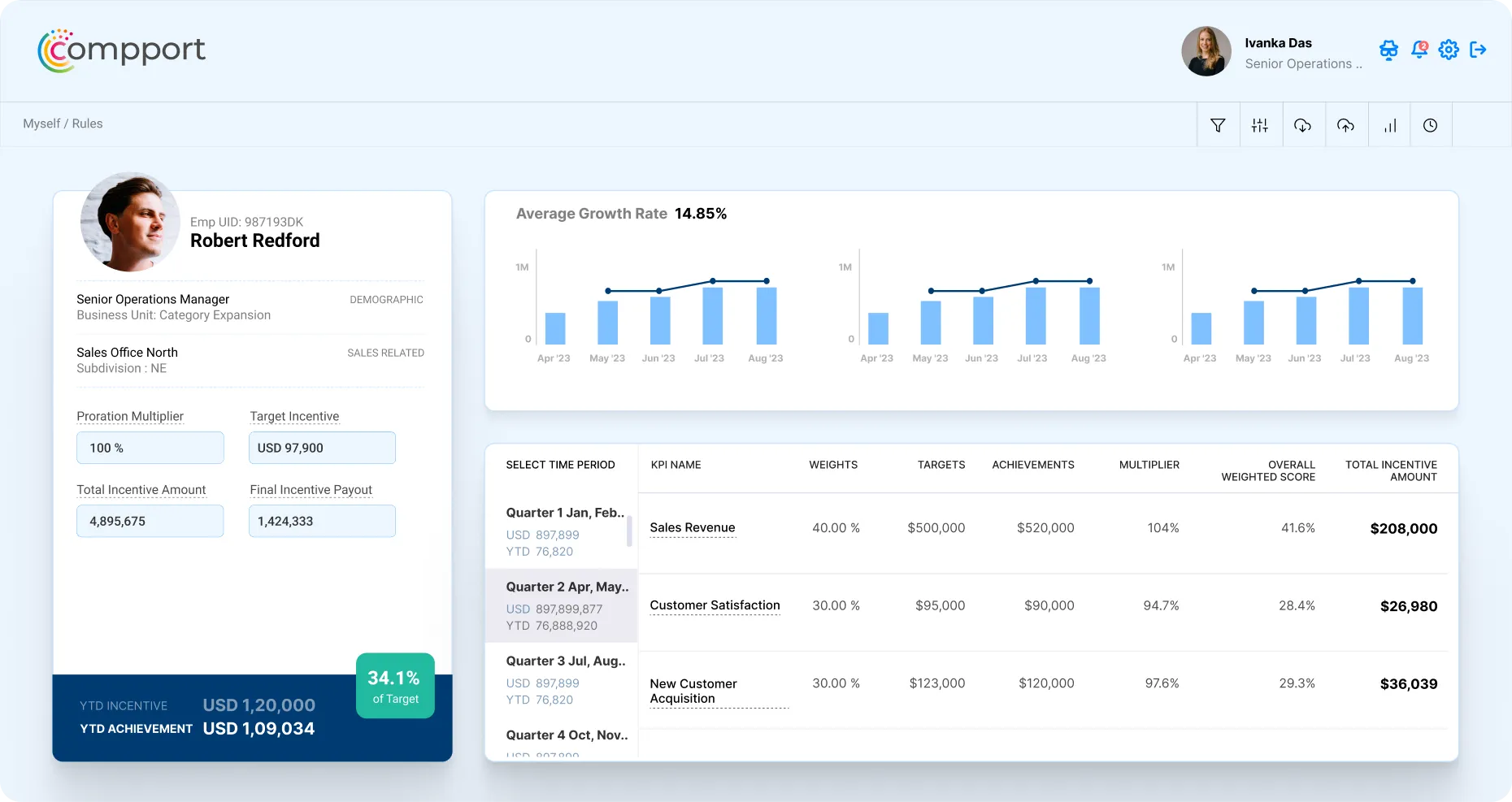
Price: Contact for pricing; modular by capability across the compensation suite
What it is: Compport is a unified compensation management platform whose Sales Incentive Plan (SIP) module handles commission and incentive calculation, payout scheduling, and rep-facing statements in the same system that runs merit, bonus, and total-rewards cycles. It's built to work whether an organization walks in with a fully defined incentive formula or just a high-level plan on paper, the platform's implementation team can structure and configure the scheme either way.
Rather than a standalone commission engine, it suits organizations that want sales incentives managed alongside the rest of their compensation programs, with a single source of truth for plan data, approvals, and audit history.
- No-code, Excel-like formula builder for tiered accelerators, quota bands, draws, and clawbacks, configured by comp admins rather than engineering, with built-in validation before logic goes live
- Data consolidation from HRMS, CRM, and sales systems through bulk upload, API, or SFTP, with inputs manageable by business unit, geography, or function and full traceability at every stage
- Mid-cycle exception handling that lets admins override rules or apply management assessments without disrupting the live cycle, with every change captured in a date and time-stamped audit trail
- Rep-facing dashboards and statements, including a self-service incentive simulator that lets reps project earnings against hypothetical performance mid-cycle
- Built-in analytics for payout trends, top earners, and incentive distribution by KPI, department, region, or cycle, with no separate BI tool required
- Configurable workflow automation that lets decentralized stakeholders across regions and time zones upload their portion of the data independently, while the system maintains centralized visibility and version control
- A carry-over tool for partial deferral of payouts (for example, 70% monthly with 30% accumulated and released at cycle-end)
- Multi-currency and multi-entity support with API-based sync to HRIS, CRM, and payroll systems
- Full audit trail and approval workflows aligned to compliance and pay-equity reporting needs
Best for: Enterprises that want sales incentives running on the same platform as merit, bonus, and total-rewards planning, rather than reconciling a standalone commission tool against a separate compensation system.
2. Qobra
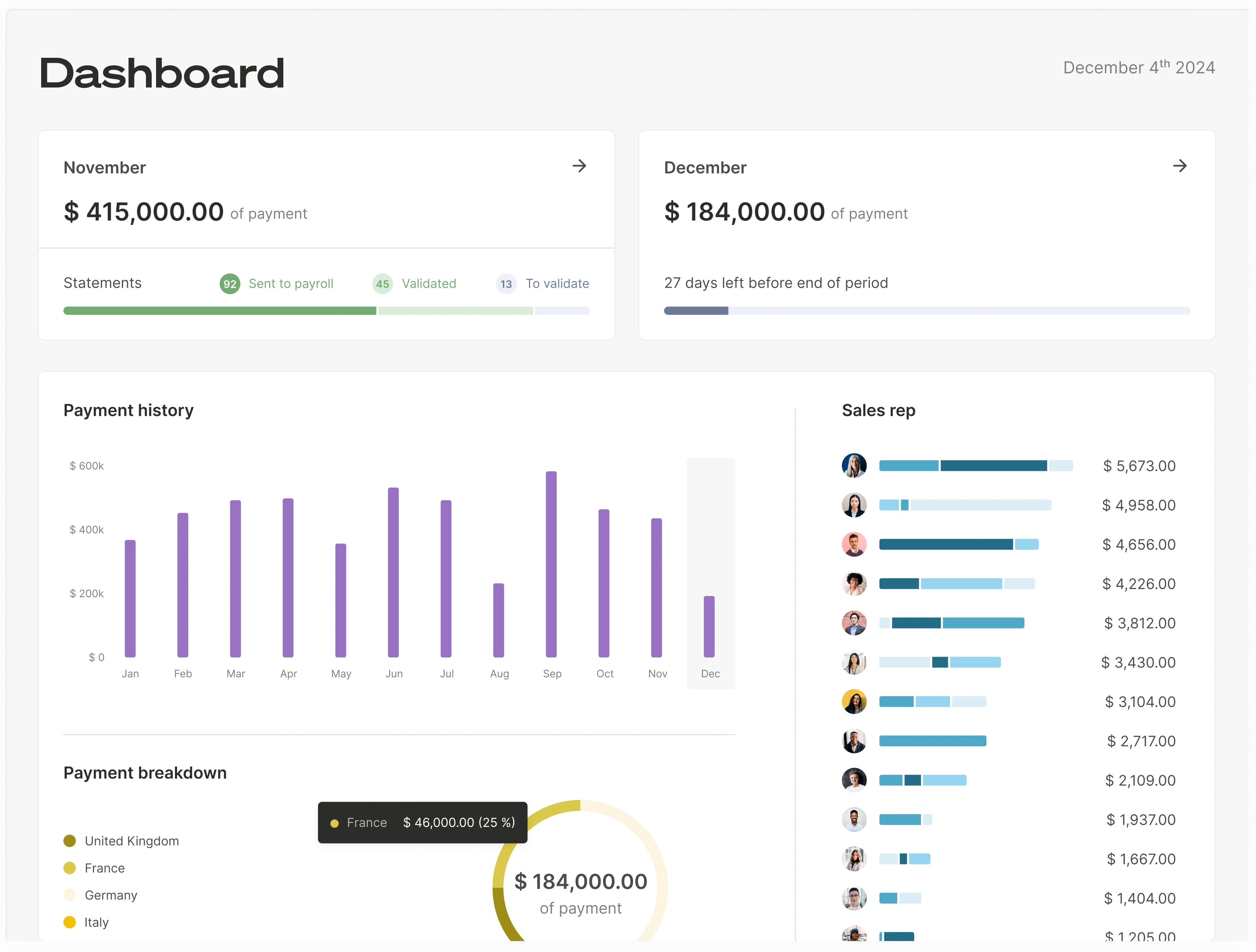
Price: Contact for pricing; quotes are tailored to payee count and plan complexity, with a demo built on your own compensation plans
What it is: Qobra is a sales compensation platform that automates commission calculations in real time from CRM and data-warehouse sources, built for RevOps and Finance teams that want reliability without spreadsheets or consultants. Its differentiator is QobrAI, three AI agents that run the repetitive comp work: the Architect builds and tests commission plans from a few prompts, the Analyst reconciles data and flags payout anomalies before month-end close, and the Sales Coach answers rep questions automatically. Over 30,000 users at companies including SAP, GoCardless, Make, ElevenLabs, and DataSnipper run commissions on it, and it holds the strongest review-platform scores in this ranking: 4.8/5 on G2 (1,000+ reviews, Best Usability badge), 4.9/5 on Capterra, and 4.6/5 on SoftwareReviews.
- AI agents that cut plan implementation from 3–6 weeks to under 48 hours, catch commission errors before payout, and reduce rep requests by up to 90%
- No-code plan builder with native integrations to Salesforce, HubSpot, and Microsoft Dynamics, plus Snowflake, BigQuery, Redshift, and NetSuite, with sandbox simulation before rollout
- Rep-facing statements with real-time earnings simulation, validation workflows across managers, HR, and Finance, audit trails, multi-currency support, and SOC 2-certified security
Best for: Mid-market to enterprise RevOps and Finance teams that want commission automation reps actually trust, customers report a 15–20% uplift in target attainment, around 5 days saved per month, and commission cycles cut from weeks to a single day.
Pricing isn’t published, so every deal starts with a demo and custom quote. Qobra is focused on sales commissions and variable pay rather than a full compensation suite — there are no merit, LTI, or pay-equity modules — and some reviewers note occasional delays in data refreshes from source systems.
3. CaptivateIQ
.avif)
Price: Custom per-seat pricing (contact for quote); seat count covers admin users plus payees
What it is: CaptivateIQ handles extract, load, and transform operations natively, eliminating the brittle pipeline workarounds that plague most ICM deployments.
- No-code plan builder lets comp admins model multi-tier accelerators, draws, and clawbacks without engineering help
- Real-time rep-facing dashboards show earned, projected, and at-risk commission in a single view
- Native integrations with Salesforce, Workday, NetSuite, and 50+ additional connectors
Best for: Mid-market enterprise organizations, particularly in SaaS, financial services, and medical devices.
Implementation requires a one-time setup fee and typically takes several weeks. ASC-606 reporting is available only as a paid add-on subscription, which adds to total cost for public companies.
4. Salesforce Spiff
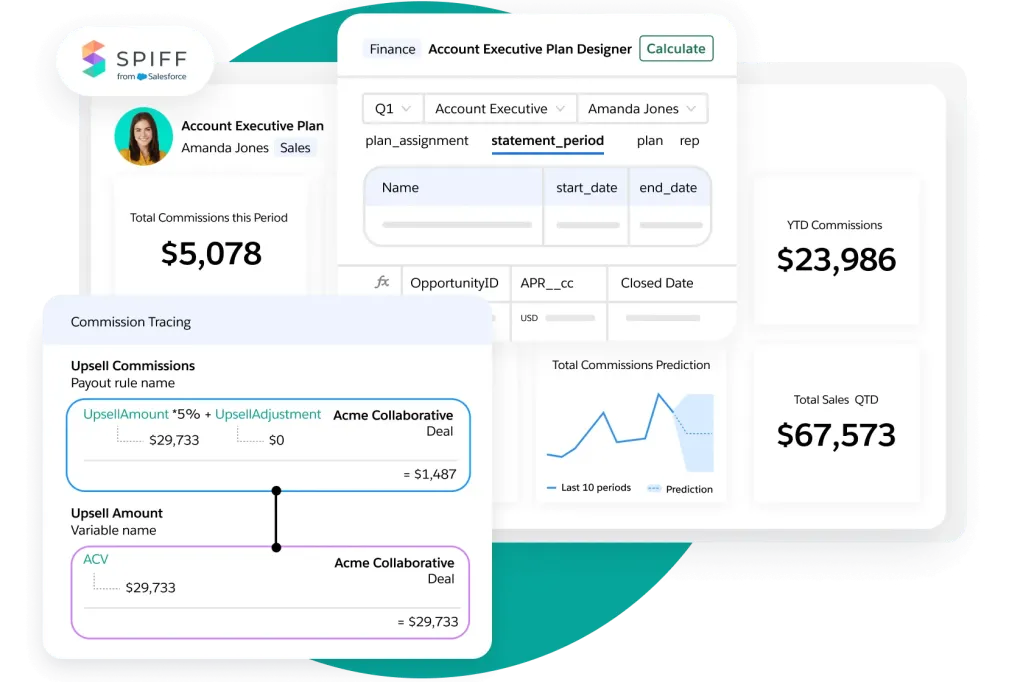
Price: Tiered public pricing; starts at approximately $25/payee/month for the base tier (as of July 2026)
What it is: Salesforce Spiff is the commission engine built directly into the Salesforce ecosystem, making it the default choice for any revenue org that runs its sales motion entirely on Salesforce CRM.
- ASC 606 and IFRS 15 compliance built into core reporting
- Bi-directional Salesforce data sync with sub-minute refresh intervals
- Native connections to Salesforce ERP, HCM, and CPQ modules
Best for: Salesforce-native organizations where CRM data is the single source of truth for commission calculations. Less compelling if your stack is HubSpot- or Dynamics-centric.
Outside the Salesforce ecosystem, integration options narrow considerably. Orgs running multi-CRM environments will find the native advantage disappears fast.
5. Everstage

Price: No publicly listed per-seat rate
What it is: Everstage is a high-growth ICM platform. It's a great fit for fast-scaling SaaS teams where plan changes happen quarterly and rep headcount grows faster than ops bandwidth.
- Transparent scoring dashboards give reps a real-time view of quota attainment without needing to ask their manager
- Automated plan acknowledgment workflows reduce dispute volume at period close
- Multi-currency payout support with configurable FX conversion rules
Best for: High-growth SaaS and tech teams prioritizing rep experience.
Enterprise-grade audit trail depth and compliance reporting are less mature. Larger organizations may hit ceiling constraints.
6. QuotaPath

Price: Starts at $25/user/month for the core plan; free trial available
What it is: QuotaPath targets RevOps and finance teams migrating off spreadsheets, offering a collaborative workspace where quota modeling, plan design, and payout tracking share a single data layer.
- RevOps and Finance collaboration view shows plan cost modeling alongside payout schedules
- HubSpot and Salesforce CRM sync with automated deal-to-commission mapping
- Rep-facing earnings tracker with mobile access
Best for: SMB to mid-market teams moving off Google Sheets or Excel.
Complex multi-tier enterprise plans with territory overlays and non-standard crediting rules can push beyond QuotaPath's current modeling depth.
7. Xactly Incent

Price: Contact for enterprise pricing.
What it is: Xactly Incent is an enterprise standard in incentive compensation management software, with over 20 years of market presence. Organizations using AI-assisted commission planning reduce plan design errors by a measurable margin compared to manual processes.
- Pre-built connectors for SAP, Oracle, Workday, and Salesforce
- Xactly Insights benchmarking layer compares your comp plan against anonymized industry data
- Full audit trail with version control for every plan change
Best for: Large enterprises with complex, multi-territory comp structures and strict compliance requirements.
Implementation timelines run longer than most competitors, often 3–6 months. The UI reflects its legacy architecture, functional but dated compared to newer entrants.
8. Performio
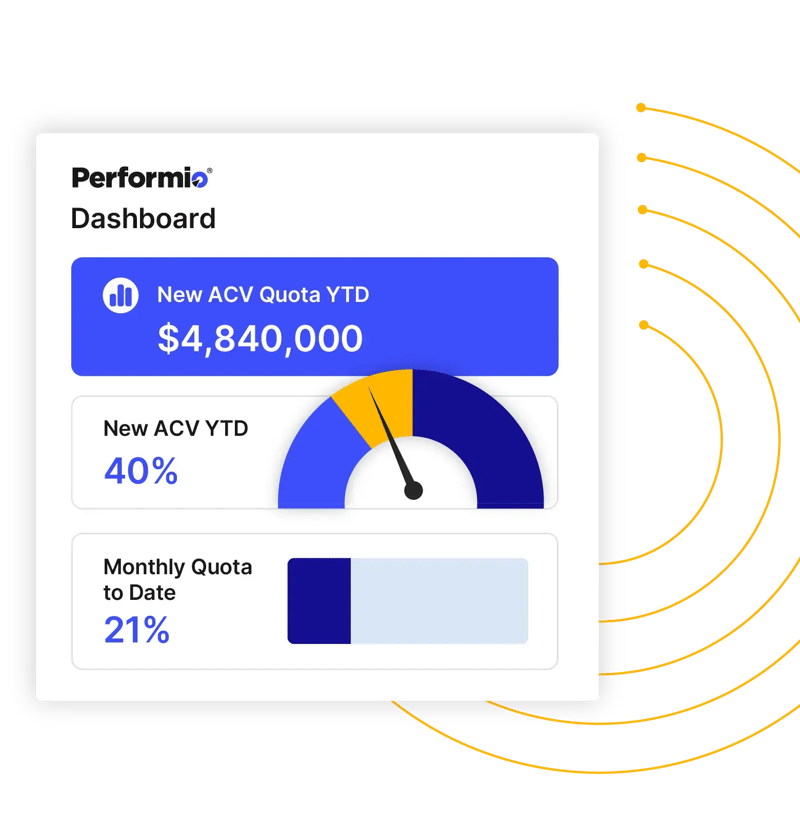
Price: Contact for pricing.
What it is: Performio is a mid-market ICM platform known for its implementation support quality and audit trail granularity. Performio's audit trail captures every data transformation step, from raw CRM input through calculation logic to final payout figure, making it genuinely useful for dispute resolution.
- Period-over-period variance reporting built into the standard dashboard
- Configurable approval chains with role-based access for finance sign-off
- Strong library of pre-built plan templates for common SaaS and distribution comp structures
Best for: Mid-market sales teams in regulated industries where audit documentation is a first-class requirement.
The integration marketplace is narrower than enterprise-tier competitors. Custom CRM connectors may require professional services engagement.
9. Forma.ai
Price: Contact for pricing.
What it is: Forma.ai differentiates itself as an AI-native commission intelligence platform. Forma.ai's core product is the predictive layer itself, modeling future payout liability, identifying quota design inefficiencies, and surfacing anomalies before period close.
- Automated payout liability forecasting updated continuously as deal data changes
- Anomaly detection flags commission calculation outliers before they become disputes
- Commission intelligence reports designed for CFO and board-level presentation
Best for: Data-forward RevOps and finance teams at growth-stage.
Pricing isn't published, so every deal starts with a custom quote. Reviewers also flag real implementation complexity, expect to lean on Forma.ai's team for setup rather than configuring plans fully self-serve out of the gate.
Which Commission Payout Software Is Right For Your Company Size?
The right commission payout tool is determined less by features than by organizational scale. Buying up in complexity costs as much as staying on spreadsheets too long.
Tier 1: Small business and startups (under 25 reps)
Needs fast, self-serve setup with transparent pricing, no procurement cycle required.
Tier 2: Mid-market (25–200 reps)
Plan variety expands here: accelerators, MBOs, SPIFs, and draw structures running simultaneously. Tools at this tier need CRM integration depth and audit trails that satisfy finance without a dedicated RevOps hire.
Tier 3: Enterprise (200+ reps, global operations)
Requires SOX-compliant audit trails, multi-currency payout support, and territory planning hooks.
One filter matters more than tier: do sales incentives need to run alongside the rest of compensation?
Organizations above 500 employees managing merit, bonus, LTI, and pay equity in addition to sales incentives are usually better served by a unified compensation platform than a standalone commission tool, since reconciling a separate SIP system against a separate comp system becomes its own overhead at that scale.
Which tier fits your organization?
1. How many employees does your company have?
2. Do sales incentives need to run alongside merit, bonus, LTI, or pay equity in one platform?
What Features Should Sales Commission Payout Software Actually Have?
Stopping second-guessing requires more than a clean UI. It requires a platform built on the right mechanical foundations. The features below are not a vendor marketing checklist. They are the capabilities that consistently determine whether a commission tool reduces finance burden or creates new ones.
A no-code, Excel-like formula builder that handles full plan complexity
Tiered accelerators, quota bands, draws, and clawbacks should be configurable directly by comp admins, with built-in validation before any logic goes live. If a plan needs an 80/120 accelerator structure or territory splits, the logic layer should handle it without engineering involvement.
Real-time, rep-facing dashboards with earnings simulation
Reps should never need to ask ops what they earned. A self-service simulator that lets reps project earnings against hypothetical performance mid-cycle removes that uncertainty entirely, not just a static dashboard.
Flexible data integration across HRMS, CRM, and sales systems
The non-negotiables are bulk upload, API, and SFTP support, with data manageable by business unit, geography, or function. Built-in validation and integration dashboards should flag traceability issues before they turn into payout errors.
Audit trails and mid-cycle exception handling
Every rule override, management assessment, or logic change should be logged with a date and time-stamped audit trail. Dispute resolution and mid-cycle changes need to be a built-in workflow that doesn't disrupt the live cycle, not a manual reconstruction after the fact.
No-code commission plan configuration
RevOps and comp teams should be able to structure and adjust schemes, whether starting from a fully detailed formula or just a high-level outline, without filing engineering tickets for every change.
Native compliance reporting for ASC 606, IFRS 15, and SOX
Audit trail and data traceability need to run through every stage of the workflow by default, so compliance and pay-equity reporting draw from existing history instead of a manual export.
Built-in analytics and what-if scenario modeling
Finance should be able to slice payout trends, top earners, and incentive distribution by KPI, department, region, or cycle directly in the platform, no separate BI tool required, and test new accelerator structures against historical attainment data before committing to them.
SIP Readiness Checklist
Build your shortlist by identifying your single most painful gap first, then filter by integration ecosystem fit second. Use this checklist to assess where your organization stands before you commit to a platform.
Compport fits when sales incentives shouldn't sit outside the rest of compensation
The right platform depends on how complex your compensation logic is today, and where it's headed in 12 months. Small teams with simple plans have plenty of standalone options. But once sales incentives need to run alongside merit, bonus, and pay equity, a separate commission tool becomes another system to reconcile, not a solution.
That's the gap Compport is built for: one platform for the full compensation picture, SIP included.

FAQs
1. What is sales commission payout software?
It's a platform that automates commission calculation, payout scheduling, and dispute resolution for sales teams, replacing manual spreadsheet tracking with real-time, audit-ready payout accuracy.
2. What's the difference between ICM software and general commission tracking tools?
ICM software handles complex plan logic like tiered accelerators and clawbacks natively. Basic tracking tools mainly log payouts without automating calculation or compliance reporting.
3. Is there free sales commission software available?
Some platforms offer free trials or entry tiers for small teams, but full plan complexity support, multi-currency payouts, and audit trails typically require a paid
4. What size sales team actually needs dedicated commission software?
Teams with more than 10 reps on variable pay, tiered structures, or multi-currency payouts typically outgrow spreadsheets and benefit most from dedicated software.
%20(96).png)
%20(95).png)
%20(94).png)