




%20(56).png)


.svg)



The exit interview says "better pay." The new job offers $2 more per hour. Seems like a no-brainer. Except that the employee just traded $48,000 in total compensation for $38,000 — and has absolutely no idea.
Here's the thing: only 10% of workers accurately understand what their benefits are actually worth. The other 90% are making career-altering decisions based on incomplete math.
This isn't about employees being financially illiterate. It's about employers spending thousands per person on benefits that stay completely invisible — right until the moment someone hands in their notice.
And in food and beverage, where margins are thin and turnover is relentless, that invisibility is costing everyone more than a $2 raise ever could.
This blog breaks down why F&B employees keep leaving — and what showing them the full picture actually does to retention.
The Turnover Crisis Runs Deeper than Pay
The average restaurant employee stays just 110 days, according to Escoffier's industry research. That's not a statistic that should be easy to read past.
Think about what 110 days actually means. Someone gets hired, trained, starts finding their rhythm — and then they're gone. The manager who spent three weeks getting them up to speed starts over. The team absorbs the gap mid-service. The productivity loss is quiet but constant, and it never fully recovers before the next person walks out.
This isn't normal wear and tear. It's a structural problem that keeps bleeding money in ways that never show up as a single line item.
And most of the time, the exit wasn't inevitable. Employees don't leave because they've made a carefully considered long-term decision. They leave because an opportunity appeared, a number looked better, and nobody gave them a reason to think twice.
So what actually pulls the trigger? A marginally higher offer somewhere else. Not a life-changing raise — just enough to feel like progress. Enough to make the discomfort of staying feel less worth it than the possibility of something new.
Nobody stops to run the full math. Nobody shows them there's more math to run.
And that gap — between what employees think they're earning and what they're actually earning — is where the real turnover problem lives.
What employees actually earn (vs. what they think)
According to the U.S. Bureau of Labor Statistics' Employer Costs for Employee Compensation report (December 2024), total compensation in leisure and hospitality averages $19.90 per hour. Employees see $16.25 on their paystub. The other $3.65 — which adds up to roughly $7,592 a year — is benefits they're not calculating.
And that's just the industry average. At larger chains with 500+ employees, benefits jump to $8.93/hour ($18,574/year). At small independents with fewer than 50 workers, it drops to $2.77/hour. Which means someone leaving a large chain for a smaller spot isn't just chasing a raise — they may be walking into a significant total compensation cut without realizing it.
Here's what that actually looks like. A full-time shift supervisor earning $16.50/hour ($34,320/year) sees one number when comparing job offers. Here's what they're not adding up:
- Costs the employer pays that never show on a paystub: Social Security and Medicare (employer share): $2,626. Unemployment and workers' comp: $606–$906.
- Benefits they know exist but never calculate: Health insurance (employer contribution): $5,300–$6,480. 401(k) match: $686. Paid time off: $1,056. Paid holidays: $792.
- Perks they use every shift but don't value: One free meal per day across 260 shifts: $2,080–$3,750. Employee dining discount: ~$520. Life insurance, EAP, training: ~$600.
That's $14,266–$16,416 in compensation that never enters the conversation.
True total compensation: $48,586–$50,736.
The employee making $16.50/hour isn't actually making $16.50/hour. They're making $23.36–$24.39/hour. So when someone offers them $18.50, it feels like a $2 raise. In reality, it's a pay cut of $4.86–$5.89/hour in total value.
The number on the offer letter wins every time — because it's the only number anyone ever shows them.
The perception gap drives bad decisions
Employers spend an average of $16,501 per employee on health benefits alone — yet one in four employees believes those benefits are worth $1,000 or less. That's not a rounding error. That's a 16x gap between what employers spend and what employees think they're getting.
According to the Benefits Value Gap Report, only 1 in 10 workers accurately understands the value of their benefits. And 40% don't consider benefits part of their compensation at all. Which means when they're comparing job offers, they're comparing apples to nothing. Just the hourly number, nothing else.
That invisibility has real consequences. When employees can't see the full picture of what they have, they make decisions based on incomplete math. And the math almost always points them toward the door.
The Great Resignation proved it the hard way. 80% of employees who left their jobs during the Great Resignation now regret it. 43% admitted they were better off at their old jobs, and about a quarter boomeranged back — most within 13 months.
They left chasing a number. Without understanding what they were giving up. And by the time they figured it out, the damage was already done — to them, and to the employer who had to replace them.
F&B has unique hidden value nobody talks about
The $2 raise gets all the attention. But there's a whole layer of compensation sitting right underneath it that nobody names, nobody quantifies, and nobody puts in front of an employee before they walk out the door. And in F&B specifically, some of these invisible benefits are genuinely unique to the industry.
The shift meal nobody calculates
Think about what actually happens every single workday. An employee clocks in, works a full shift, and eats a meal — one they didn't pay for. It happens so routinely that it stops feeling like a benefit. It's just lunch.
But those meals add up to real money over a year. And because meals provided on the employer's premises for the convenience of the employer are excluded from employees' gross income under IRS Section 119, that value lands tax-free — which makes it worth more, dollar for dollar, than a taxable wage increase of the same amount.
Employees hardly factor this in when they're comparing offer letters.
Earned wage access changes the financial reality
For a lot of restaurant workers, the gap between earning money and accessing it is genuinely stressful. Bills don't wait for payday. When an employer offers earned wage access — letting workers tap into what they've already made before the scheduled pay date — it's not just a perk. It removes a real financial pressure point.
Leaving a promotion pipeline for a pay bump
Restaurant career progression is faster than almost any other industry. No degree required. A clear path from crew to shift lead to manager to GM — often within three to five years. The median annual salary for food service managers was $65,310 as of May 2024, according to the BLS.
When an employee leaves a chain with a strong internal promotion track for a $2/hour bump at a place with no upward mobility, they're not just switching jobs. They're trading a clear trajectory for a marginally better starting point — and giving up far more in future earnings than they're gaining today.
Tip seniority is earned, not transferred
For servers and bartenders, seniority isn't just about respect — it directly affects income. Station assignments, regular customers, high-traffic shifts — these take time to build. A new hire at a different restaurant starts over. Bottom of the rotation. Weekday lunches. Rebuilding from scratch — and potentially losing thousands in tip income during that period.
The $2 raise doesn't account for any of this. It never does.
Transparency solves this, but almost nobody does it
The fix isn't complicated. It's just uncommon.
When employees can see their full compensation picture — not just the hourly rate, but every dollar their employer actually spends on them — the decision to leave for $2 more gets a lot harder to make.
According to Mercer's 2023-2024 study, employees who believe they are paid fairly are 85% more engaged and 62% more committed to their organization. The keyword there is "believe." Fairness isn't just about what you pay. It's about what employees understand.
And right now, most don't.
We already know that only 10% of workers accurately understands the value of their benefits. So when they compare job offers, they're comparing incomplete pictures. The employer who shows them the full picture first wins — almost by default.
That's what a total rewards statement does. Not a policy document. Not a benefits portal buried in an HR system. A simple, personalized breakdown:
- Here's your base pay
- Here's what we spend on your health coverage
- Here's the value of your shift meals
- Here's your PTO in dollar terms
- Here's what you're actually earning
- Total: this number.
The format matters too, especially in F&B.
A PDF emailed once a year doesn't reach a line cook who doesn't have a work laptop. It needs to be mobile-first, visual, and easy to understand in under two minutes. The technology to do Platforms like Compport's Total Rewards Statement module let HR teams build personalized statements that show each employee their actual numbers, not a generic summary.
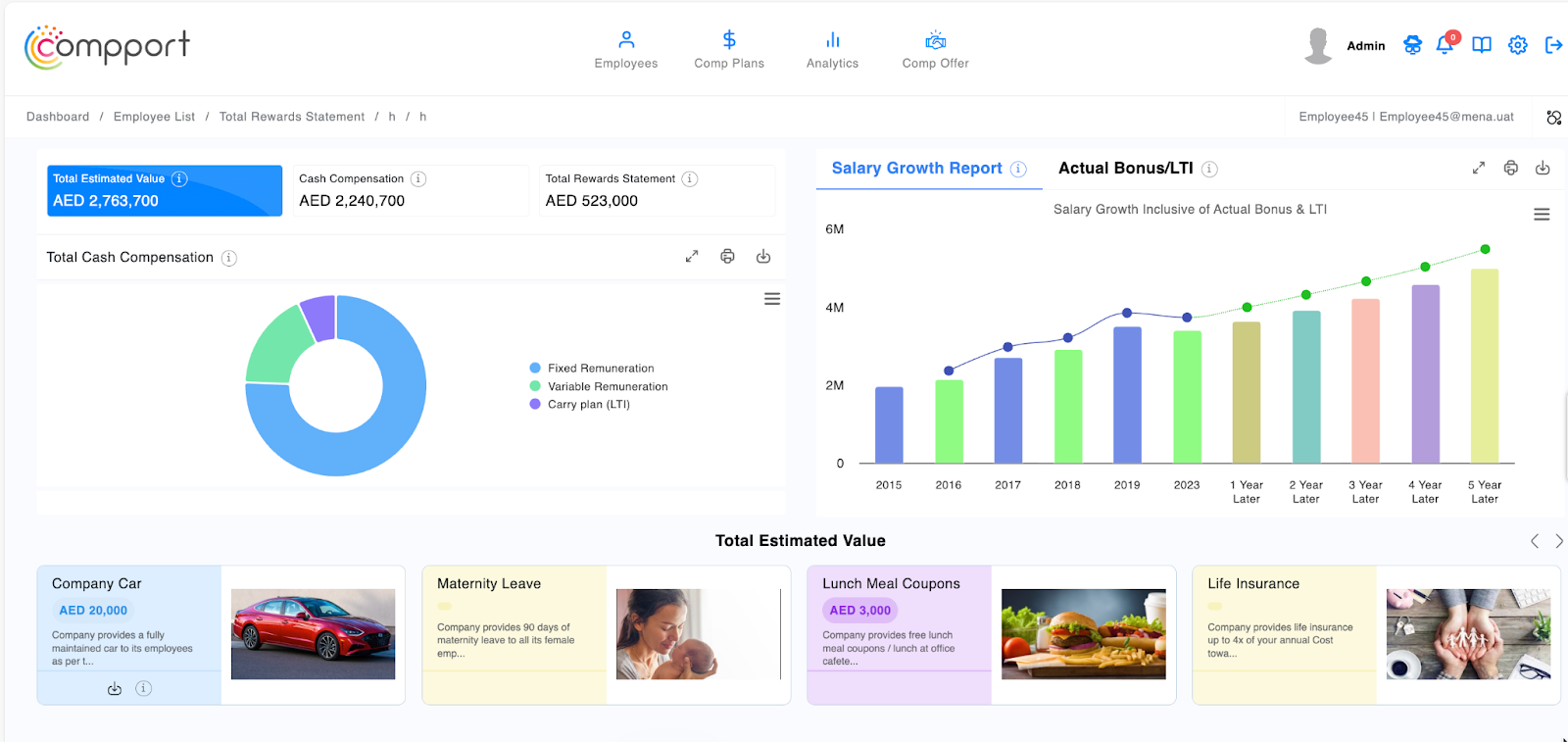
The ROI is straightforward. If a restaurant is already losing hundreds of thousands a year to turnover, retaining even two or three employees more than pays for the entire program. The math works. The question is simply whether anyone bothers to show employees what they already have — before someone else offers them $2 more.
Here’s how to create a Total rewards statement using Compport TRS builder:
The problem isn't compensation — it's communication
F&B employers are spending thousands per employee on benefits that stay completely invisible — right until the exit interview. By then, it's too late. The decision is made. The notice is handed in. And somewhere across town, a line cook is starting a new job for $2 more an hour, about to discover that the math never quite added up the way they thought it would.
That's not a pay problem. That's an information problem. And information problems have information solutions.
The employers who retain people aren't necessarily the ones paying the most. They're the ones making sure employees understand what they already have — before someone else makes them an offer they can't evaluate properly.
That's exactly what Compport's Total Rewards Statement module is built for. Not a policy document. Not a once-a-year PDF.
A clear, personalized breakdown of everything an employer spends on each employee — in a format that actually reaches a frontline worker and makes sense to them in under two minutes.
Show people the full picture. Before they start comparing numbers they don't fully understand. Because the conversation that prevents a resignation is always cheaper than the one that happens after it.

FAQs
Why do F&B employees leave for small pay increases?
Because they're only comparing hourly wages. Benefits, shift meals, earned wage access, and career growth rarely enter the calculation. When nobody shows employees their full compensation picture, a $2 raise looks like an obvious win — even when it isn't.
What is a total rewards statement and why does it matter in F&B?
A total rewards statement breaks down everything an employer spends on an employee — beyond base pay. In F&B, where shift meals, earned wage access, and career progression add significant value, showing employees this full picture directly reduces the urge to leave for marginally higher wages elsewhere.
How much does employee turnover actually cost a restaurant?
More than most operators realize. When you factor in lost productivity, recruitment, and training — not just the hiring fee — replacing one frontline worker costs thousands. For a mid-size restaurant running high annual turnover, that adds up to a number that dwarfs the cost of simply retaining people.
Do restaurant employees actually care about benefits beyond pay?
They care deeply — they just don't always know what they have. Only 1 in 10 workers accurately understands the value of their benefits Once employees see the full value of health coverage, retirement contributions, and daily perks like shift meals, their perception of fair pay shifts significantly.
What can F&B operators do today to improve retention?
Start with visibility. Audit what you're already spending per employee beyond wages. Then communicate it — clearly, personally, and in a format frontline workers can actually access. Tools like Compport's Total Rewards Statement make this straightforward, without requiring a large HR team or a complicated rollout.
%20(90).png)
%20(85).png)
%20(89).png)