




%2520(48).png)


.svg)



2026 merit budgets hold steady at 3.5%, but uniform raises waste limited budget compared to data-driven, performance-based allocation
21 US states now require salary range disclosure, yet only 19% of companies feel prepared to defend the pay structures behind those ranges
70% of organizations budget for pay equity adjustments, but only 26% have actually run a pay gap analysis to find where the gaps are
The FLSA overtime threshold jumped to $58,656, reclassifying millions of workers and adding fresh compliance pressure across states
Compensation strategy varies sharply by industry, so tech, finance, retail, and healthcare each need different allocation and retention levers
Compensation planning isn't on autopilot anymore.
Your 2026 budget sits around 3.5% – stable but not generous. Meanwhile, 21 U.S. states require disclosure of salary ranges. The overtime threshold jumped to $58,656. Employees expect proof of pay equity. Compliance requirements multiply across jurisdictions.
The standard playbook of uniform raises and reactive adjustments no longer works. You need targeted allocation strategies, proactive equity analysis, and built-in compliance tracking.
This guide covers what's changing in 2026: merit budget allocation, transparency requirements, equity management, compliance updates, and industry-specific trends.
We'll provide practical frameworks for each challenge and show how compensation management platforms can automate the complex calculations and tracking required for modern pay decisions.
#1 Merit Budgets Hold Steady at 3.5%
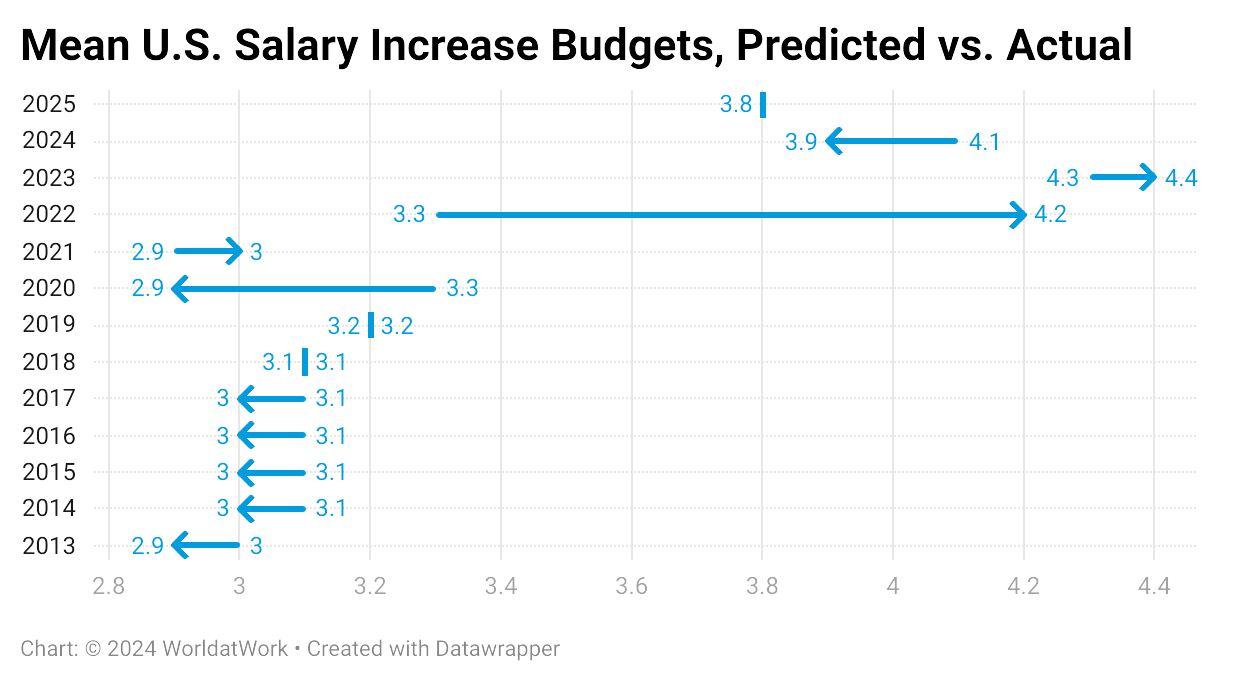
Salary increase budgets for 2026 are projected at 3.5-3.6%, according to WorldatWork's 2025-2026 Salary Budget Survey. This represents a slight decrease from 2025's actual 3.7% and continues the stabilization trend after pandemic-era spikes. While lower than the 4%+ seen during recent labor shortages, it remains above the 3% norm of the 2010s.
Uniform distribution wastes these limited resources.
When everyone gets 3.5%, high performers feel undervalued while average performers lack the incentive to improve. Critical roles remain under market. The result: turnover in positions you can't afford to lose and retention of mediocrity you can't afford to keep.
Data-driven allocation delivers better outcomes: Leading organizations differentiate significantly. Top performers receive 5.6% increases. Average performers get 3.3%. They reserve 0.5-1% of payroll for off-cycle market adjustments and equity corrections.
They identify critical roles first through retention-risk analysis and market-competitiveness data. Performance ratings drive individual decisions. Separate promotion budgets—typically funding 10% of employees with 8.5% increases—reward advancement without depleting merit pools.
This approach requires discipline and clear communication.
- Managers need training to explain differentiated increases.
- Employees need transparency about performance expectations.
But the payoff is significant: improved retention of top talent, better performance alignment, and more efficient use of limited budgets.
Companies still using spreadsheets to allocate 3.5% evenly will lose their best people to those using analytics to invest strategically.
#2 Pay Transparency: Beyond Posting Salary Ranges
Twenty-one US states mandate salary range disclosure by the end of 2025, each with specific requirements.
- California, Colorado, and New York require ranges in all job postings.
- Maryland and Connecticut mandate disclosure upon request.
- Rhode Island and Nevada include internal transfer postings.
- Illinois and Massachusetts will join in 2025 with their own variations.
Multistate employers face a patchwork of rules. Many adopt nationwide transparency rather than manage different requirements by location.
“Can you explain why you pay what you pay — and can you do it in objective terms? That’s the foundation of real transparency.” - Anita Lettink, Founder of HRTechRadar
The readiness gap reveals deeper issues: Only 19% of companies feel prepared for transparency requirements, according to Aon's Global Pay Transparency Study. The problem isn't posting ranges—it's having defensible pay structures behind them. When employees can't get clear answers about their pay, they assume bias or unfairness.
What's actually blocking progress: Most organizations haven't audited whether their ranges reflect market reality after recent volatility. Positions hired aggressively in 2021-2022 may have ranged 20% above similar roles. Long-tenured employees often sit below the minimum of updated ranges.
Managers lack training to explain why two employees in the same role earn different amounts within the range. Without clear criteria for range placement based on skills, experience, and performance, these conversations fail.
The fix requires systematic preparation.
- Update ranges based on current market data.
- Document clear criteria for the position within the range.
- Train managers before they face questions.
Companies treating transparency as a compliance checkbox rather than an opportunity to build trust will struggle with both retention and recruitment.
Transparency Requires More Than a Salary Band
Posting ranges isn’t enough—employees want to understand why they’re paid what they’re paid.
Compport’s Total Rewards Statement module goes beyond compliance. It delivers personalized, real-time visibility into salary, bonus, equity, and benefits—plus the rationale behind each.
That means:
- ✔️ Managers communicate with confidence
- ✔️ Employees get clarity, not confusion
- ✔️ You stay ready for audits, questions, and talent conversations
TRS isn’t just a document. It’s your transparency infrastructure.
#3 Pay Equity Requires Analysis, Not Just Budget
70% of organizations allocate funds for pay equity adjustments—typically 0.5% of payroll—yet only 26% have conducted actual pay gap analysis. You're budgeting to fix problems you haven't identified.
Where equity gaps actually hide: Pay compression from pandemic hiring remains widespread. Engineers hired in 2021-2022 at premium rates now work alongside five-year veterans earning less when new graduate salaries approach senior developer pay, retention risk spikes.
WorldatWork data show salary structures adjusted by only 2.5% in 2025, while individual raises averaged 3.8%, worsening compression.
Remote work policies create unintended demographic gaps.
Mercer reports that remote workers received 3.6% raises, compared with 4.0% overall. Since women and caregivers disproportionately choose remote work for flexibility, lower increases for remote employees can create or widen gender pay gaps.
Geographic pay differentials add complexity.
Same role, different locations, varying pay—but
- Are adjustments consistent?
- Are they documented?
- Can you defend them if challenged?
Building equity into a compensation structure: Effective programs start with comprehensive audits.
- Analyze pay by demographics, controlling for role, tenure, location, and performance.
- Document unexplained gaps.
- Update salary structures annually—not just individual salaries—to prevent compression.
- Train managers to recognize bias patterns.
Performance ratings that consistently favor in-office presence over actual output. Promotion decisions that overlook remote workers. Starting salary negotiations that perpetuate historical gaps.
Fix systems, not just symptoms. If your process creates gaps, adjustments only provide temporary relief. Review how starting salaries are set, how raises are determined, and how promotions are decided. Build equity checkpoints into each decision point.
#4 Compliance: Build It In Before It Breaks Your Budget
The FLSA overtime exemption threshold jumped to $58,656 on January 1, 2025—up from $35,568. Employees below this threshold must receive overtime pay regardless of title. The Department of Labor will adjust this automatically every three years starting in 2027. No more decade-long freezes.
This change reclassified millions of workers overnight. Administrative roles at $45,000, junior managers at $52,000—all now overtime-eligible unless you raised their salaries above the threshold.
State and local requirements compound complexity: While federal minimum wage remains at $7.25, states and cities continue raising their floors. California and New York exceed $15/hour. Seattle, San Francisco, and other cities set higher rates. These increases don't just affect entry-level positions—they compress entire pay scales upward as you maintain differentials.
Many states index minimum wage to inflation, triggering automatic annual increases. Your 2026 budget needs to account for scheduled changes plus potential mid-year adjustments.
Reporting requirements expand beyond posting: California requires employers with 100+ employees to submit pay data reports by gender, race, and ethnicity. Illinois mandates equal pay certifications. Colorado demands job posting compliance even for remote positions. The EU Pay Transparency Directive affects any company with European operations.
Each jurisdiction sets different deadlines, different formats, and different penalties.
Miss California's May deadline? Face fines starting at $100 per employee.
Post a remote job without Colorado salary ranges? Risk penalties plus reputational damage.
Make compliance systematic, not reactive: Build location-based wage tracking into your compensation platform. Set alerts three months before any minimum wage or threshold change. Review exemption classifications during annual planning, not after violations surface.
Document your compliance process.
- Which roles need review when thresholds change?
- Who monitors multi-state requirements?
- How do posting templates get updated?
Without systematic processes, compliance becomes an expensive emergency every January.
#5 Industry Compensation Trends Shape Different Realities
Compensation strategies that work in tech fail in healthcare. Retail tactics don't translate to banking. Your industry's specific labor market, margin structure, and regulatory environment determine which levers you can actually pull.
Technology: The correction continues
Tech salary budgets drop from 4.0% in 2025 to 3.5% for 2026, according to multiple surveys. The market has split: AI and machine learning specialists still command premiums, while routine development roles face softer demand.
Companies that overhired in 2021-2022 are still normalizing their pay scales. Equity compensation remains critical—but with volatile stock prices, the total compensation equation keeps shifting. Innovative tech HR teams differentiate sharply within their workforce rather than applying blanket increases.
Financial Services: Performance drives everything
Base salary increases in finance match the 3.5% average, but variable pay tells the real story. Banking and insurance firms emphasize documented pay-for-performance more than ever, driven by regulatory scrutiny.
These organizations typically have more formalized structures and robust documentation than other industries, as they must justify compensation decisions to regulators and shareholders. Many major banks already post salary ranges nationally, ahead of requirements.
Retail and Hospitality: Margin pressure limits options
These sectors show the lowest increases at 3.0-3.1%. Restaurant profit margins of 3-5% leave no room for significant base pay growth. Yet minimum wage increases hit these industries hardest, affecting large percentages of their workforce.
Creative retention strategies replace salary increases: signing bonuses, rapid promotion paths, same-day pay, and tuition assistance. When you can't compete on wages, you need other differentiators. Budget for high turnover—it's structural in these sectors.
Healthcare: Shortage-driven disparities
Healthcare averages 3.5-3.6% increases overall, but the variation within the sector is extreme. Registered nurses in critical specialties, mental health professionals, and specialized technicians see much higher increases, plus signing bonuses. Meanwhile, some hospital systems facing financial pressure limited 2025 raises to 2.8%.
The workforce spans from minimum-wage support staff to highly-paid physicians, making uniform strategies impossible. Shift differentials, overtime, and crisis pay significantly affect total earnings. Pay equity scrutiny intensifies, particularly around physician compensation disparities.
Cross-industry lessons
Manufacturing faces skilled trade shortages, driving above-average increases for specific roles. Every sector has pockets of acute competition alongside areas of surplus.
Don't assume your industry's average applies uniformly. Identify your specific talent bottlenecks, understand your margin constraints, and build strategies that work within your reality.
Bringing It All Together: Your 2026 Compensation Playbook
Compensation planning now determines talent outcomes. The organizations treating it as strategic infrastructure, not annual administration, win the best people. Try it yourself below with Compport's compensation planning module:
Leading enterprises run compensation as a continuous cycle.
- They model scenarios before budgets lock
- They track equity gaps monthly rather than annually
- They give managers real-time data during compensation conversations
This agility means adjusting quickly when competitors move, regulations change, or talent markets shift.
Your immediate action plan:
- Audit current pay structures against market reality. Identify compression, equity gaps, and compliance risks
- Get stakeholder alignment on tradeoffs—cost control versus competitiveness, internal equity versus market rates
- Then evaluate whether your current systems can handle multi-state compliance, real-time equity monitoring, and scenario planning.
Real Results: How Storable Transformed Compensation with Compport
When Storable — a fast-growing tech company with 900+ employees — outgrew spreadsheets and inflexible tools, they turned to Compport to simplify and scale their global compensation processes.
Key Outcomes:
- 50% faster merit and bonus cycles
- Custom scorecards fully supported without costly workarounds
- Equity and bonus logic automated — eliminating manual errors
- ADP integration completed in just 2 days
- Managers onboarded in under 20 minutes, with built-in budget guardrails
- Global + local flexibility — country-specific rules and letters in one system
- Live dashboards enabling objective, data-backed leadership decisions
“Compport's tool and implementation process provides a large degree of customization for your processes and allows for a simple and consistent approach to global comp cycle management.”
— Jonathan Lewis, Global People Operations Executive, Storable
The 2026 priorities are clear: precision in targeted allocation, transparency in pay decisions, fairness across demographics, and work arrangements.
Manual processes can't deliver all three. Start building your playbook now, waiting until Q4 means scrambling when you should be executing.
If you’re still using spreadsheets in 2026, you’re already behind. Compensation is moving too fast for manual fixes.

FAQs
Who should use this playbook?
This playbook is for HR, Total Rewards, Compensation, and People Ops leaders looking to plan merit budgets, navigate new transparency laws, address equity risks, and stay compliant across multiple jurisdictions in 2026.
What makes 2026 different from previous years?
Stable salary budgets (3.5%), a growing patchwork of pay transparency laws (21 states and counting), a significant jump in the FLSA overtime threshold, and rising equity and compliance expectations—all require proactive, data-backed planning rather than reactive adjustments.
How can I apply these frameworks to my own team?
Start by auditing your salary ranges, identifying pay compression or compliance gaps, and aligning stakeholders on your compensation philosophy. Then, assess whether your current tools allow you to manage equity, transparency, and budgeting effectively.
%20(97).png)
%20(96).png)
%20(95).png)